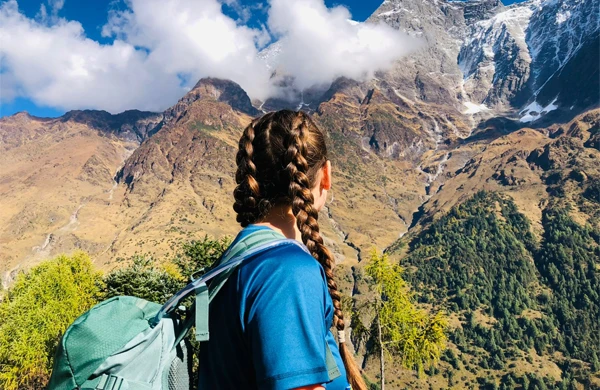
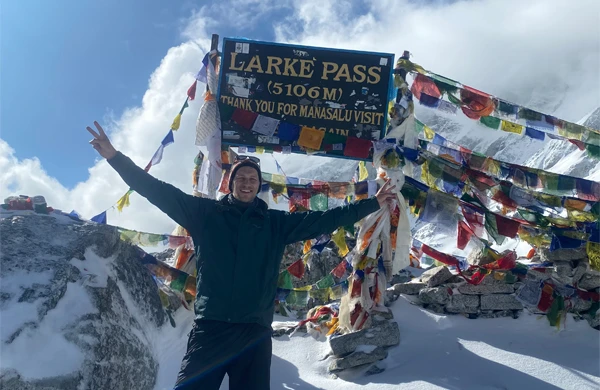
The Manaslu Circuit Trek falls within the Manaslu Region as well as a small part in the Annapurna Region. This means the trekking trail is also a part of the Manaslu Conservation Area and the Annapurna Conservation Area. The two conservation areas are the protected areas of Nepal and are responsible for the protection and conservation of the biodiversity and the geographical landscape.
Established in 1998, the Manaslu Conservation Area became the second conservation area after the Annapurna Conservation Area. After the immense success of the Integrated Conservation and Development Programme (ICDP) in ACAP, the National Trust for Nature Conservation (NTNC) established the Manaslu Conservation Area for developing basic ecotourism infrastructure in the area.
The mountainous region of the Manaslu has a fragile but diverse natural resource base and a rich cultural environment. The Manaslu Conservation Area covers 1663 square kilometers. seven wards of Chumnubri Rural Municipality: Sirdibas, Chumchet, Chhekampar, Bihi, Prok, Lho and Samagaun.
The manaslu region remained isolated in terms of both development and tourism for the longest time and only opened for trekking in 1991. But due to the lack of proper infrastructure to support tourists, it remained limited to few numbers of tourists until recent times.
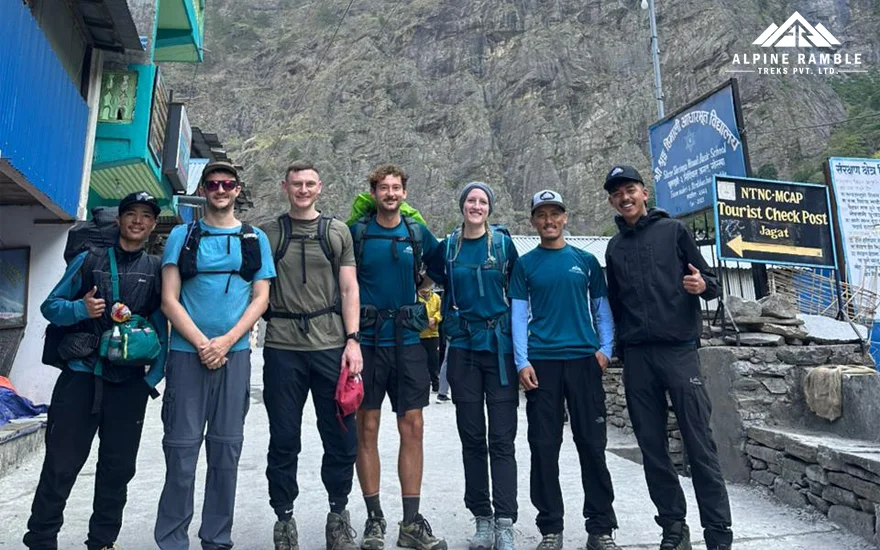
Now there are main offices of MCAP in Philim and Sirdibas, as well as two tourist check posts and information centers in operation in Jagat and Samagaun. So the main objective of the Manaslu Conservation Area Project is to conserve and sustainably manage the natural resources and rich cultural heritage and to promote ecotourism to improve the livelihood of the local people in the MCA region.
That being said, the permits are an essential part of the trekking program and a mandatory requirement. So on this blog, you will learn the most latest information regarding the requirement of the Manaslu Circuit Trek permits for the big year of 2026.
What are the permits required for the Manaslu Circuit Trek in 2026?
As previously mentioned, for being able to do the Manaslu Circuit Trek, you are required to have four separate trekking permits, and each permit has its own specific purpose. The names of the permits for the Manaslu Circuit Trek in 2026 are listed and explained below:
- the Manaslu Restricted Area Permit (MRAP),
- the Manaslu Conservation Area Permit (MCAP),
- the Annapurna Conservation Area Permit (ACAP), and
- the Chumnubri Rural Municipality Permit.
Manaslu Restricted Area Permit
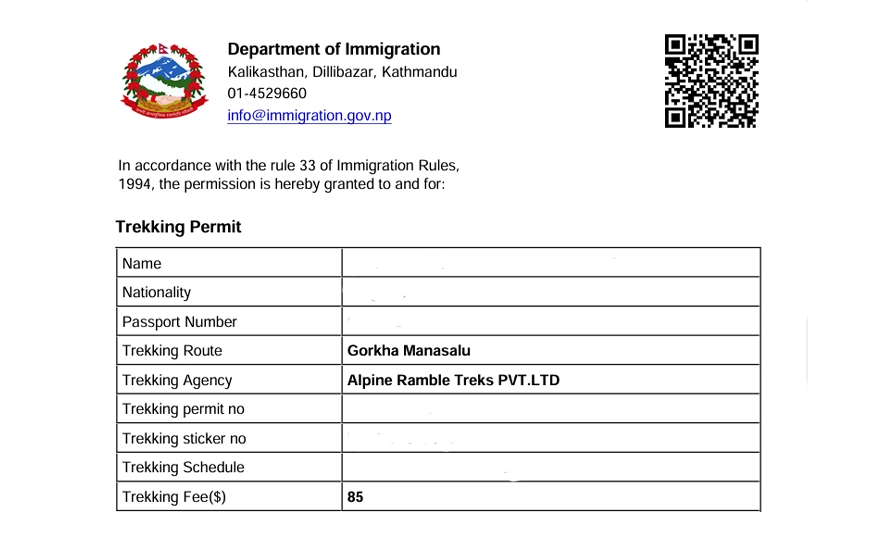
The Manaslu Restricted Area Permit is a special area permit that is issued under the Department of Immigration system of Nepal. As the Manaslu Region is a legally designated restricted area, getting the permit is very important. And because it is a restricted area, free movement and especially solo trekking is not allowed.
As the Manaslu Circuit Trek primarily passes the 1, 2, 3, and 4 wards of Chumnubri Rural Municipality, having the restricted area permit covering all four wards is extremely important. Since this permit is only issued by the Department of Immigration, it is not the same as other permits required for the Manaslu Circuit Trek.
Manaslu Conservation Area Permit
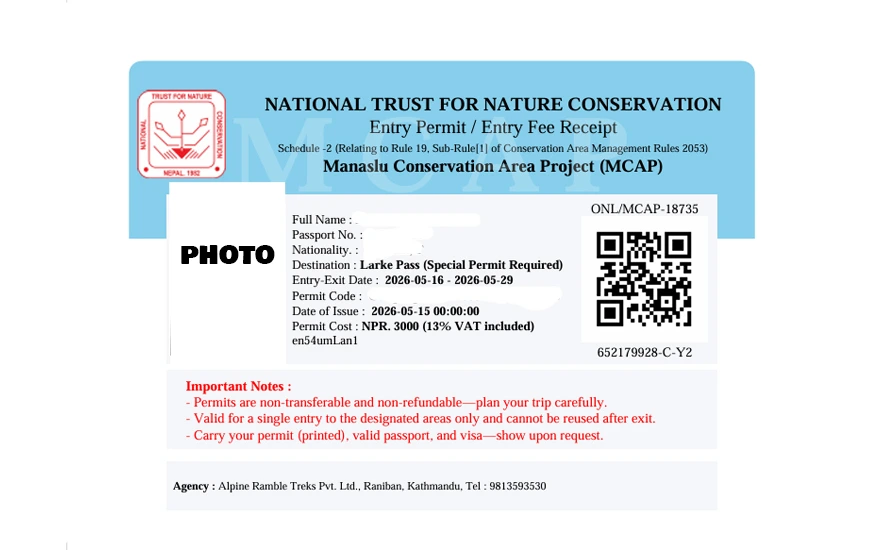
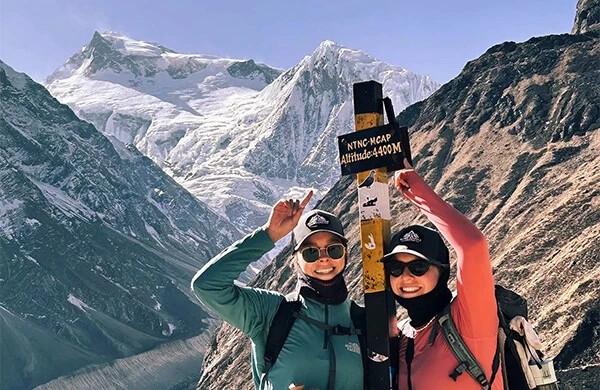
The Manaslu Conservation Area Permit, commonly called MCAP, is the entry permit required for not only the Manaslu Circuit Trek but also for treks like Tsum Valley since both are part of the Manaslu Conservation Area.
This permit is issued by the NTNC and the conservation area and is required because the route passes through a legally declared region of the protected area, which is managed by Nepal’s conservation system.
As mentioned above, the Manaslu Conservation Area was declared on December 28, 1998. And it covers approximately 1,663 square kilometers, which includes all the wards of Chumnubri Rural Municipality.
NTNC identifies Jagat as the main entrance to the Manaslu Conservation Area. From there, the standard circuit continues through protected landscapes and communities, including areas within Sirdibas, Bihi, Prok, Lho, and Samagaun.
Chumnubri Rural Municipality Permit
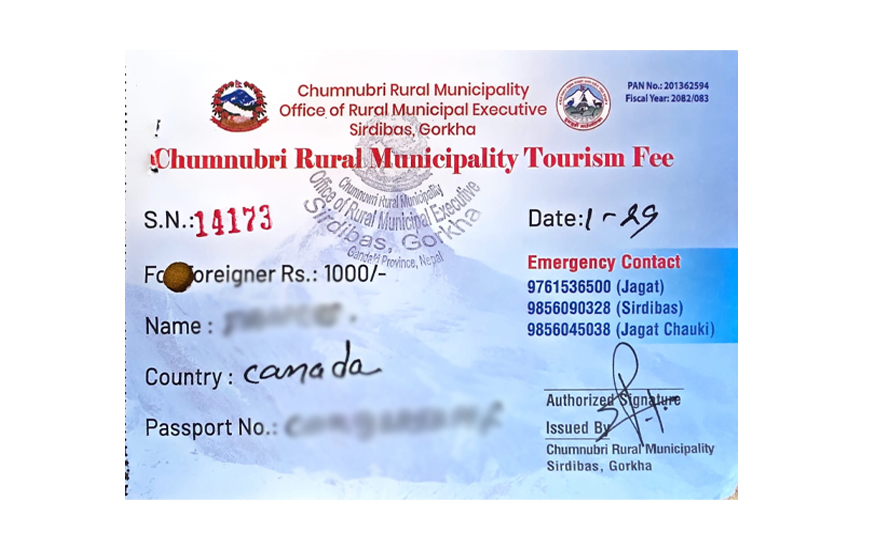
In addition to the Restricted Area Permit, MCAP, and ACAP, trekkers also need a Chumnubri Rural Municipality Permit, a permit issued by the local municipality itself. It is paid as a fee for the entry to the municipality and the tourism fee.
Chumnubri Rural Municipality introduced the charge for visitors entering the Manaslu Conservation Area within its jurisdiction. The revenue generated from this permit will directly be used for the betterment of the local communities on the Manaslu Circuit trail as well as the villages on the trail of the Tsum Valley.
The municipality stated that the revenue would support tourism and local development activities, including trail and bridge construction, tourist safety, waste management, fire control, shelters, rest stops, signposts, water facilities, environmental conservation, and tourism training for local residents.
Annapurna Conservation Area Permit
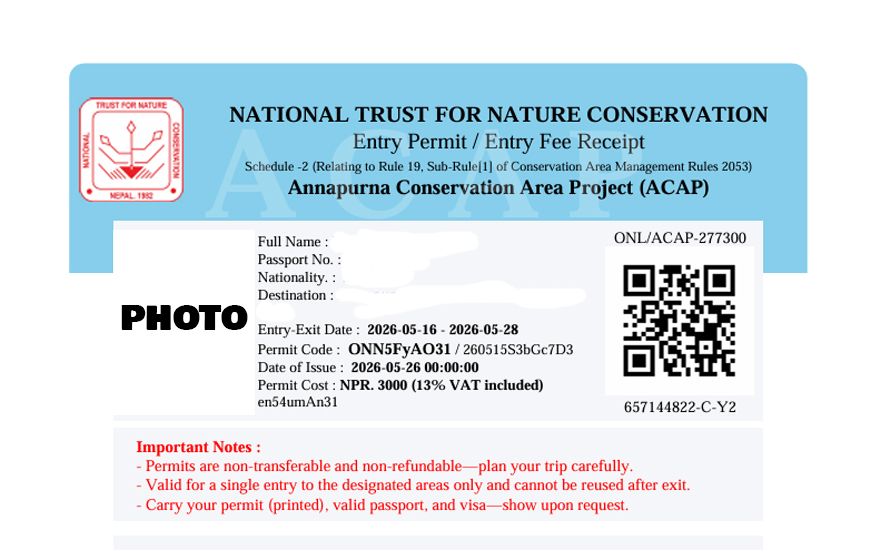
The Annapurna Conservation Area Permit, usually called ACAP, is required when the Manaslu Circuit itinerary enters the Annapurna Conservation Area.
The standard Manaslu Circuit normally crosses Larkya La and descends toward Bhimtang, Gho, Tilije, and Dharapani. This route joins the Annapurna region near the end of the trek. Because the Manaslu and Annapurna conservation areas are separately designated protected areas, MCAP does not provide entry into ACAP territory.
The exact requirement should always be linked to the actual itinerary. A modified route that does not enter the Annapurna Conservation Area may not have the same permit combination.
Manaslu Circuit Trek Permit Cost for 2026
The Manaslu Circuit Trek requires four different fees set by different authorities, so there is an expected difference in the cost of the permits. For your easy understanding, the cost for each permit is showcased on the table below:
Manaslu Restricted Area Permit Cost
The cost for the Manaslu Restricted Area Permit depends on two things, the trekking seasons and the number of days covered by the permit.
| Trekking period |
Fee for the first 7 days |
Fee for each additional day |
| September to November |
USD 100 per person |
USD 15 per person per day |
| December to August |
USD 75 per person |
USD 10 per person per day |
The initial fee covers seven days. When the approved stay within the permit-covered area exceeds seven days, the relevant daily charge is added for each extra day.
Issuing authority: Department of Immigration, Government of Nepal
Manaslu Conservation Area Permit Cost
The Manaslu Conservation Area Permit, commonly called MCAP, is required for entry into the Manaslu Conservation Area. The cost for this permit is separated at a different price point as for international and SAARC nationals.
| Visitor category |
Manaslu Conservation Area Project fee |
| International visitors |
NPR 3,000 per person |
| SAARC nationals |
NPR 1,000 per person |
Unlike the Restricted Area Permit, the cost for the MCAP remains the same throughout the different seasons and has no known time limit. Once issued, you can use it as long as your itinerary and schedule days.
Managing authority: National Trust for Nature Conservation
Annapurna Conservation Area Permit Cost
The Annapurna Conservation Area Permit is required because after the completion of the Larkya La Pass, the trail descends down and meets the Annapurna Circuit Trek. And similar to the Manaslu Conservation Area, the cost for the Annapurna Conservation Area Permit also has a similar cost, as it is managed by the same authority.
| Visitor category |
Annapurna Conservation Area Project fee |
| International visitors |
NPR 3,000 per person |
| SAARC nationals |
NPR 1,000 per person |
Managing authority: National Trust for Nature Conservation
| Visitor category |
Reported municipal fee |
| International visitors |
NPR 1,000 per person |
| SAARC nationals |
NPR 200 per person |
Collecting authority: Chumnubri Rural Municipality
Is a TIMS Card Required for the Manaslu Circuit Trek?
No, a TIMS card is not required for the Manaslu Circuit Trek. Known as the Trekker’s Information Management System, the TIMS card isn’t required for the Manaslu Region but only if the trek to the Annapurna Circuit Trek is continued.
Why Are Permits Required for the Manaslu Circuit Trek?
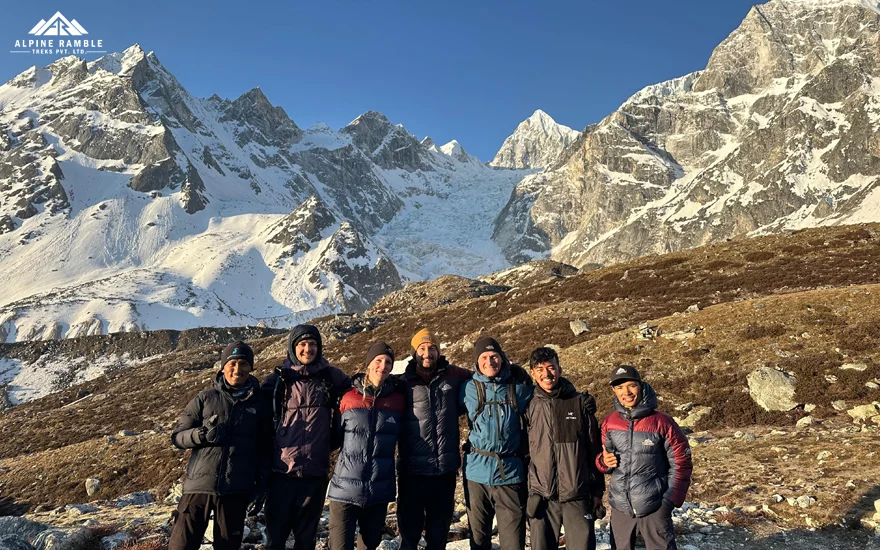
The Manaslu Conservation Area is a legally managed protected area by the NTNC and the Manaslu Conservation Area Project. Thus, the permits required for this trek are issued by the government-designated restricted area and legally protected conservation areas. These permits are required for a multitude of reasons, and they are listed below:
- To regulate travel through the designated Manaslu Trekking Region
- To control entry into the Manaslu Conservation Area
- To protect wildlife, habitats and natural resources
- To record visitor and itinerary information
- To ensure compliance with local rules
- To manage tourism responsibly
- To enter the Annapurna Conservation Area
Why one permit cannot replace the others
Each permit applies to a different authority or geographical area:
- The Manaslu trekking permit is administered through the Department of Immigration system and applies to the areas listed in its Gorkha–Manaslu permit table.
- MCAP provides entry into the Manaslu Conservation Area.
- ACAP provides entry into the Annapurna Conservation Area when the itinerary reaches that protected area.
Which parts of Manaslu are restricted?
According to the department of Immigration, both Gorkha and Manaslu are listed under the restricted area. For the Manaslu Region, all areas of wards 1, 2, 3 and 4 of Chumnubri Rural Municipality are put under the restricted area zone.
The restricted area of the Manaslu region follows the upper Budhi Gandaki River valley in Gorkha District from Jagat north to Samagaun and Samdo and the Tibetan border, with the separate Tsum Valley branch.
Key Restricted Zones
- Upper Budhi Gandaki/Manaslu Circuit Route
- Tsum Valley Route
Documents Required for the Manaslu Circuit Trek Permits
For all four of the Manaslu Circuit Trek permits, there are common documents, so having them or their photocopies can be used to get all the permits. However, the Restricted Area Permit requires some additional information because it is processed through the Department of Immigration.
| Document or information |
Why it is required |
| Clear passport copy |
Confirms the trekker’s identity, nationality, passport number and personal details. |
| Recent passport-size photograph |
Helps identify the permit holder and is required for digital permit applications. |
| Full name and date of birth |
Ensures the information printed on the permit matches the passport. |
| Nationality |
Determines the correct permit category and fee, especially for foreign and SAARC nationals. |
| Confirmed trekking itinerary |
Shows the planned route and identifies which permit areas the trekker will enter. |
| Expected entry and exit dates |
Records the travel period and helps calculate the Restricted Area Permit fee. |
| Contact details |
Allows the permit authority to maintain an accurate visitor record. |
| Emergency contact details |
Provides a contact person if an emergency occurs during the trek. |
Note: All information should match the traveller’s passport. Incorrect names, passport numbers or travel dates may create delays or problems when permits are checked along the route.
Additional Requirements for the Manaslu Restricted Area Permit
The following details may also be required because this permit is processed through the Department of Immigration:
Valid Nepal visa details: Confirms that the traveller is legally staying in Nepal.
Restricted-area entry and exit dates: Helps calculate the permit duration and any additional daily fees.
Registered trekking agency details: Identifies the agency submitting the application.
Guide or group leader details: Connects the permit with the organized trekking team.
Agency application or recommendation letter: Formally supports the request submitted to the Department of Immigration.
Additional Requirements for MCAP and ACAP
Correct conservation area selection: Ensures the applicant receives the correct permit for Manaslu or Annapurna.
Digital passport-size photograph: Used to identify the permit holder in the electronic application.
Online payment details: Required when paying through the NTNC e-permit system. MCAP and ACAP are separate permits. Therefore, the correct conservation area must be selected for each application even though the personal documents are the same.
How to acquire the permits for the Manalsu Circuit Trek?
To acquire one of the Manaslu Circuit Trek permits, the restricted area permit, it must be done through a Nepal government-registered trekking agency using the Department of Immigration system. Applying independently for a foreign national is not allowed. The Immigration citizen charter requires the applicant agency’s trekking license and other agency documents for restricted-area permit processing.
While other remaining permits such as MCAP and ACAP can be applied independently, trekking solo without a guide is also not allowed. Nowadays, everything can be processed online so it is much more time saving and efficient. Therefore, for smooth operation and experience, choosing a reputable agency is highly recommended.
Content Summary
The Manaslu Circuit Trek is a one-of-a-kind journey that takes you deep into the Himalayas, which has remained untouched for many years up until recently when they opened for commercial trekking. It is by far one of the most remote trekking experiences you can get when trekking in Nepal.
From dense alpine forests in the lower region to the villages with unique culture and intricate architecture, crossing Larkya La high pass to beautiful panoramic mountain views, the Malanslu Circuit Trek is an adventure from start to finish. But to be able to experience such an adventure, getting the permits is extremely important. The Manaslu Circuit Trek requires four different permits because the route passes through a restricted trekking area, the Manaslu Conservation Area, and, on the standard itinerary, the Annapurna Conservation Area.
The four permits are the Manaslu Restricted Area Permit (MRAP), the Manaslu Conservation Area Permit (MCAP), the Annapurna Conservation Area Permit (ACAP), and the Chum Nubri Rural Municipality Local Permit. The restricted area permit cannot be issued independently, and so it must be arranged through a registered trekking agency in Nepal.
So booking with Alpine Ramble Treks comes with the advantage of not only getting the permits but also the arrangement of food, accommodations, and transportation services. Our itineraries are designed with care and the trekker’s experience in mind so each journey becomes an unforgettable memory. All your permits will be arranged before you begin your trek, and all you have to do is enjoy everything thoroughly.
Whether you are planning for a private trip or joining a group spontaneously, Alpine Ramble Treks got you covered from permits to everything.
Frequently Asked Questions (FAQs) about Manaslu Circuit Trek Permits
1. Can I obtain the Manaslu permits at the trailhead?
The permits should be arranged before the trek. NTNC states that conservation permits issued directly at check posts cost double the standard fee.
2. Do I need a separate permit for Tsum Valley?
Yes. Tsum Valley is listed separately from the Gorkha–Manaslu area and has its own permit coverage and fee structure.
3. Can foreign trekkers apply for the Restricted Area Permit themselves?
No. The permit must be arranged through a government-registered trekking agency in Nepal.
4. Can foreign trekkers apply for MCAP and ACAP independently?
Yes. They can apply through the NTNC e-permit portal, visit an NTNC permit counter, or ask their trekking agency to arrange the permits.
5. Are MCAP and ACAP valid for multiple entries?
No. NTNC states that its conservation-area permits are valid for single entry only.
6. What happens if I stay in the Manaslu permit area for more than seven days?
An additional daily fee applies after the first seven days. The amount depends on the trekking season.
7. Are Manaslu permit fees refundable?
No, MCAP and ACAP along with the Restricted Are permits are non-refundable.
8. Can a permit be transferred to another traveler?
No, the NTNC conservation permits are non-transferable and are issued using each traveller’s personal details.
9. Do permit fees include guide and agency charges?
No, the permit fees are separate from guide costs, TIMS fees, agency service charges, transportation and other trekking expenses.
10. Do children need MCAP and ACAP?
Children below 10 years do not require NTNC conservation-area permits. The Restricted Area Permit rules should be checked separately with Immigration.
11. Do Manaslu permit prices change by season?
The Restricted Area Permit fee changes by season. MCAP and ACAP currently have fixed fees throughout the year.
12. What should I do if my permit contains incorrect information?
Contact the trekking agency or issuing authority before beginning the trek. Names, passport numbers, route details and dates should be checked carefully before submission.
13. Must trekkers carry their permits during the trek?
Yes. Immigration requires trekkers to keep the Restricted Area Permit with them, and NTNC requires conservation permits to be carried throughout the trip and presented when requested.
14. Do I need new permits for another Manaslu trip?
Yes. NTNC permits are valid for single entry, while Restricted Area Permits are issued for approved travel dates and permit coverage. A later trip requires new permits.
References Used
Trekking Route and Permit Fee
Nepal Trekking Permit Fees
निषेधित क्षेत्रहरु र पदयात्रा | Department of Tourism
NTNC Online permit