Manaslu Circuit Trek 12 Days
US$990US$1290
Book Now

Manaslu Circuit Trek 12 Days

1530+ reviews in TripAdvisor
400+ reviews in Google
106+ reviews in TrustPilot
Trip Facts
Duration12 Days
Trip GradeEasy-Moderate
CountryNepal
Maximum Altitude5106 meters
Group Size2-12
StartsKathmandu
EndsKathmandu
ActivitiesTrekking/Hiking
Best TimeMar-May, Sep-Nov
Overview

Fastest Complete Route Around Mount Manaslu (8,163 m)

Wondering how the Manaslu Circuit Trek brings the most authentic trek experience to the table?

Fast. Compact. High-fitness required. One of the most demanding yet rewarding condensed Manaslu trek options in Nepal.

There are journeys you remember, and journeys that quietly rewrite you from the inside. The Manaslu Circuit Trek 12 days belongs to the latter, not a checklist trek, but a living corridor through a Himalaya that resisted the modern world until very recently.

Although Mount Manaslu itself was first climbed on 9 May 1956 by the Japanese expedition of Toshio Imanishi and Gyalzen Norbu, the surrounding valleys remained closed to foreign trekkers for decades. Only in 1991 did Nepal open the region as a restricted trekking area, with controlled access still in place today.

The result is rare.

Exploration here feels contemporary rather than historical, as if the map is still catching up with the terrain.

Unlike heavily trafficked routes such as Everest Base Camp or the Tour du Mont Blanc, this short Manaslu Circuit trek does not present itself immediately. It reveals itself slowly, through river gorges, forests, and high valleys where the scale of the landscape recalibrates your sense of distance.

Here, discovery still feels possible. The remote trails do not merely show you the Himalaya, they allow you to encounter it much as earlier explorers did, uncertain, immense, and profoundly alive.

For travelers with limited time but strong endurance, this route represents the fastest Manaslu trek option that still completes the entire circuit.

12 Days Around Manaslu Trek At a Glance

Detail Information
Duration 12 Days (Kathmandu to Kathmandu)
Trek Distance ~160–180 km
Highest Point Larkya La Pass — 5,106 m
Max Mountain Manaslu — 8,163 m (World’s 8th highest)
Start Elevation ~900 m at Machha Khola
End Connection Dharapani, Annapurna region
Accommodation Local teahouses
Difficulty Moderate to challenging
Permit Status Restricted Area
Guide Requirement Mandatory
Best Seasons Spring (Mar–May), Autumn (Sep–Nov)

Price by Group Size

Transparent pricing allows both solo travelers and groups to plan realistically for this Manaslu trek for limited time travelers.

Group Size Cost per Person
1 pax US$1199
2–4 pax US$1099
5–9 pax US$979
10–15 pax US$969
15–30 pax US$899

All required permits, guiding services, accommodation, and core logistics are arranged in advance.

Why the Manaslu Trek Requires Licensed Guides and Special Permits

Independent travel is not permitted in this restricted region, not as a limitation but as a safeguard. The route lies close to the Tibetan border and passes through terrain that is geologically active, culturally sensitive, and climatically unpredictable.

Licensed local guides serve as navigators, translators, safety monitors, and cultural interpreters.

With experienced teams such as Alpine Ramble Treks, this quick Manaslu Circuit route becomes structured without feeling packaged, allowing travelers to move confidently through a landscape that demands respect.

Major Highlights of the Short Manaslu Circuit Trek (in 12 Days)

  • Views of Mount Manaslu (8,163 m), Himalchuli, Ngadi Chuli, Cheo Himal, Kang Guru, and Ganesh Himal
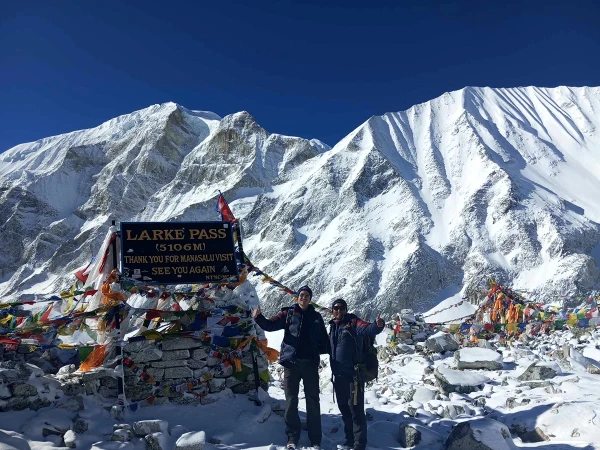
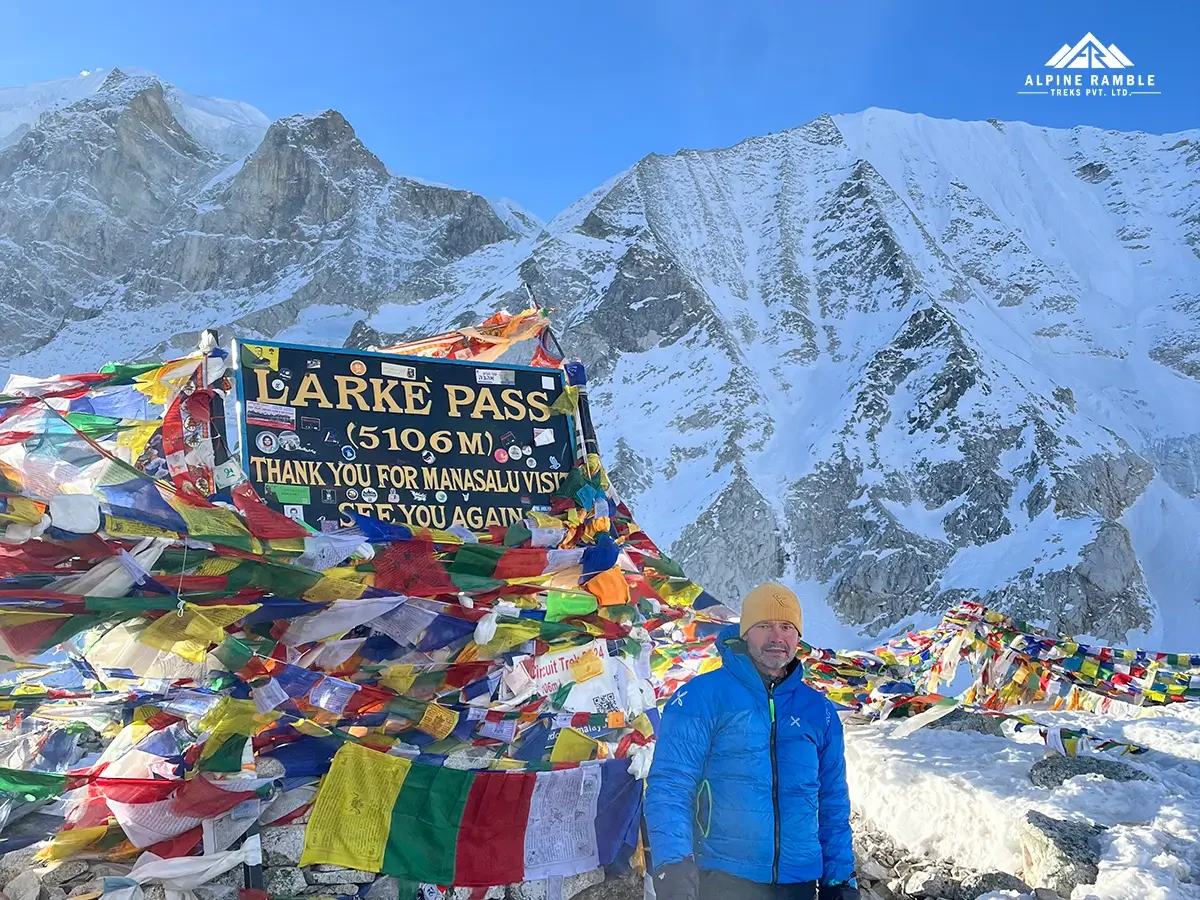
  • Crossing Larkya La Pass at 5,106 m, one of Nepal’s most dramatic high passes
  • Possible sightings of snow leopard habitat, blue sheep, Himalayan tahr, and the Himalayan Monal
  • Cultural immersion among Gurung, Magar, and Tibetan communities
  • Visits to monasteries such as those near Nubri and Pungyen
  • Dense forests, waterfalls, suspension bridges, and glacial landscapes
  • Authentic regional cuisine and teahouse hospitality
  • Significantly fewer crowds than Everest or Annapurna routes

This condensed Manaslu trek delivers the essential experiences of the full circuit without extending into a longer expedition timeframe.

Following the Budhi Gandaki River Into the Manaslu Himalaya

The trek begins at Machha Khola, where warm air carries the scent of earth, vegetation, and river water. Soon the Budhi Gandaki River asserts itself as the defining presence of the journey, carving one of the deepest gorges in the Himalaya.

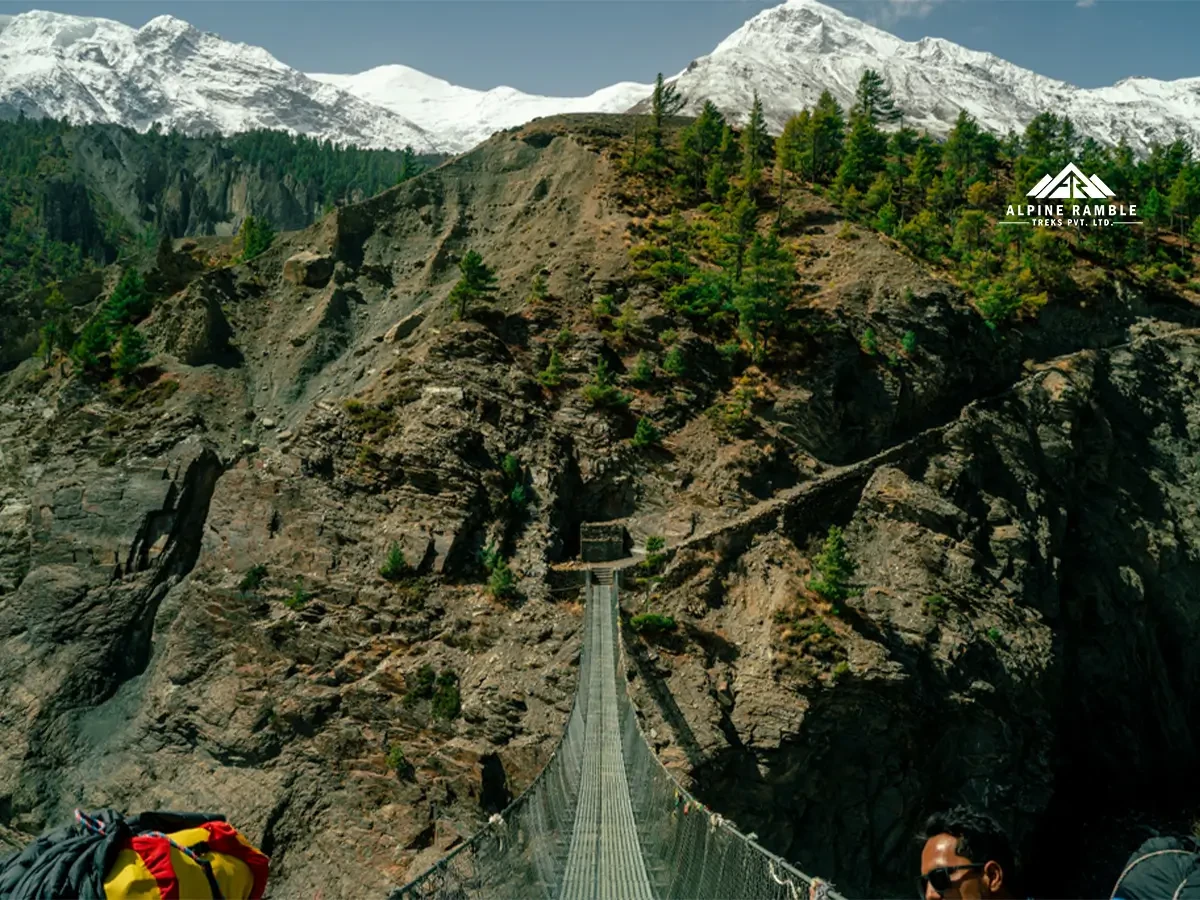
Waterfalls plunge from unseen heights. Suspension bridges sway above torrents of white water. Villages such as Jagat, Deng, and Ghap cling to steep slopes, appearing less constructed than inherited from generations past.

Step by step, the world grows quieter, wilder, older.

This section of the trail forms the opening stage of the express Manaslu trek itinerary, where elevation gain begins gradually but steadily.

From Middle Hills to Tibetan Buddhist Highlands

Higher elevations bring visible cultural change. Timber houses give way to stone structures with flat roofs designed for snow. Mani walls inscribed with sacred texts line the trail. Prayer wheels spin slowly in the wind.

At Lho and Shyala, the immense north face of Manaslu rises abruptly into view, a vast wall of ice and shadow that dominates the horizon.

Samagaon, shaped by centuries of trade and isolation, moves to the rhythms of yak caravans, seasonal cycles, and monastery life. Nearby Birendra Lake reflects the mountain in still turquoise water, creating an image that feels almost unreal in its symmetry.

This stage represents the transition into the high-altitude core of the Manaslu Circuit short itinerary Nepal travelers often seek when time is limited.

Crossing Larkya La Pass (5,106 m)

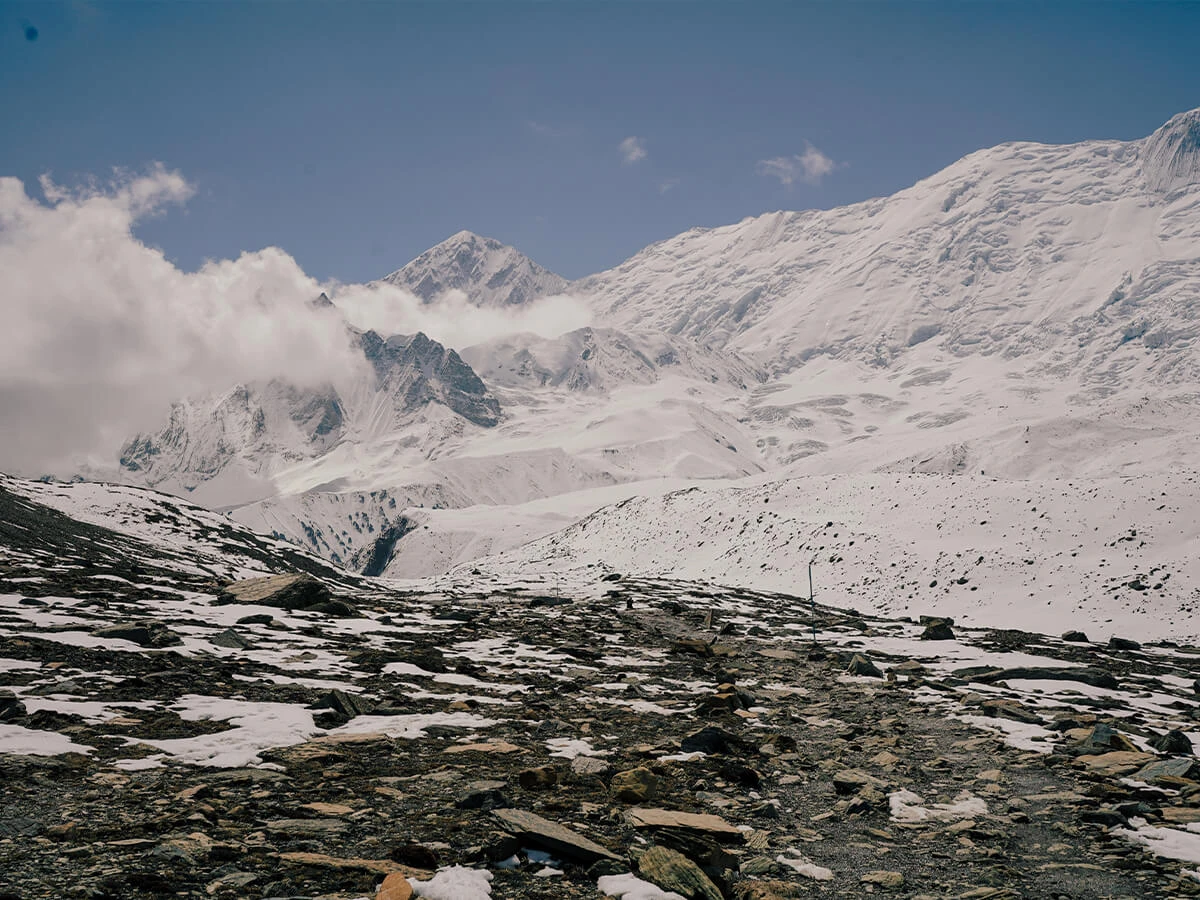
Beyond Samdo and Dharamsala, vegetation disappears and the terrain becomes stark and elemental. The ascent to Larkya La begins before dawn, headlamps tracing a quiet line across snow and rock.

As daylight spreads, peaks emerge in every direction, Manaslu, Himalchuli, Cheo Himal, Himlung Himal, Kang Guru, Annapurna II, Lamjung Himal, an overwhelming concentration of high Himalayan summits.

Standing on the pass, fatigue gives way to something deeper, a sense of scale that is difficult to express but impossible to forget.

For many trekkers, this crossing defines the entire quick Manaslu Circuit route, compressing the drama of a multi-week expedition into a single demanding day.

Descending from Manslu Into the Annapurna Region

On the southern side of the pass, glaciers recede and alpine meadows return. Around Bhimthang, grazing animals and wildflowers soften the landscape. Soon rhododendron forests reappear, followed by Gurung villages where warmth radiates from kitchens long before it reaches the air outside.

By Dharapani and onward to Besisahar, the trail reconnects with the Annapurna region and with modern infrastructure, the return to everyday life happening gradually rather than abruptly.

Within a matter of days, trekkers move from arctic conditions to fertile valleys, a vertical journey few places on Earth can compress into a single route.

Short Manaslu vs Everest Base Camp and Annapurna Circuit Trek

Everest Base Camp and Annapurna attract large numbers of trekkers each year and offer extensive infrastructure. Manaslu remains deliberately controlled, preserving both ecosystem and experience.

Here, silence is still possible. You may walk for hours accompanied only by wind, water, and your own breathing.

Many experienced trekkers choose the Manaslu trek for fit trekkers not because it is easier, but because it feels more authentic and far less crowded.

Trekking with Alpine Ramble Treks

With more than two decades of guiding experience and a global community of trekkers, Alpine Ramble Treks provides local expertise, logistical coordination, and safety oversight while allowing the journey to retain its sense of exploration.

Permits, accommodation, pacing, and contingency planning are handled quietly in the background. Travelers are free to focus on the landscape, culture, and personal experience unfolding around them.

Major Himalayan Peaks Visible

Mountain Height Notes
Manaslu 8,163 m World’s 8th highest
Himalchuli 7,893 m Major peak in the region
Ngadi Chuli 7,871 m Also called Peak 29
Manaslu North 7,157 m Prominent northern summit
Ganesh Himal 7,422 m Visible from lower sections

A Journey Beyond Geography

The Manaslu Circuit Trek 12 days is not merely about reaching the far side of a mountain.

It is a passage through deep time, from humid river valleys to glacial wilderness, from Hindu lowland settlements to Tibetan Buddhist highlands where prayer flags snap in winds that have crossed entire continents without touching a city.

Somewhere along the way, distance stops being measured in kilometers and begins to be measured in perspective.

Additional Benefits of this trek with only ART

  • Free Airport transportation on arrival and departure days (We will pick you up and drop you off)
  • Trekking equipment such as the Sleeping bag, Down jacket, and walking poles (rental is included if needed)
  • Duffle bag if required (Optional)
  • Souvenir: Trekking route map/browser and printed ART's hiking T-shirt
  • An Oximeter to measure your Oxygen and Pulse at a high altitude to find out accurate health conditions while you are trekking in the mountain.
  • WOKI TOKI - for communication during the tre
Itinerary

Manaslu Circuit Trek 12 Days Day-by-day Plan Itinerary

Kathmandu to KathmanduExpand all
Max Altitude: 850 m | 2789 ft. Meals: Lunch and dinnerAccommodation: Tea HouseDuration: 9-10 hours, approxDistance: 160 km

Your journey begins by leaving Kathmandu, Nepal’s historic capital at 1,400 meters, and following the Trishuli River west along the Prithvi Highway, completed in stages during the 1970s. After DhadingBesi and Arughat, the road becomes rougher as you enter Gorkha District, birthplace of King Prithvi Narayan Shah, who unified Nepal in the 18th century.

Soti Khola marks the traditional gateway to the Manaslu region. From there, the road continues along the Budhi Gandaki River to Machha Khola, a small settlement that serves traders, trekkers, and local farmers. The night is spent in a simple tea house beside the river, with the sound of water replacing city noise.

Max Altitude: 1,340 m (4397 ft) Meals: Breakfast, Lunch, and DinnerAccommodation: Tea HouseDuration: 6-7 hours, approxDistance: 16-17 km, approx


The walking begins along the Budhi Gandaki, one of Nepal’s most powerful mountain rivers. The trail alternates between riverside paths, forest sections, and suspension bridges that replaced older wooden crossings vulnerable to monsoon floods.

You pass Tatopani, known for its natural hot springs used for bathing and healing long before tourism. Terraced fields of millet, maize, and rice reflect subsistence farming traditions that remain central to village life.

Jagat functions as the official entry checkpoint for the restricted Manaslu area, where permits introduced after 1991 are verified

Max Altitude: 1,860 m (6103 ft) Meals: Breakfast, Lunch, and DinnerAccommodation: Tea HouseDuration: 6-7 hours, approxDistance: 17-18 km, approx

Beyond Jagat, the valley narrows dramatically. The trail climbs high above the river, offering views of waterfalls and steep cliffs. You pass Philim, a large Gurung settlement that historically served as an administrative and agricultural center during Nepal’s Panchayat era (1960–1990).

Gurung communities are well known for service in Gurkha regiments since the early 19th century. Multiple suspension bridges cross the gorge before you reach Dyang, a quieter village surrounded by forested slopes

Max Altitude: 2630 m (8629 ft) Meals: Breakfast, Lunch, and DinnerAccommodation: Tea HouseDuration: 6-7 hours, approxDistance: 17 km, approx

Vegetation transitions toward pine and rhododendron forests as altitude increases.Apple orchards introduced in the late 20th century appear along the trail, part of agricultural programs designed to support mountain livelihoods.

Snow peaks begin to emerge, including Himalchuli and Ngadi Chuli. Langur monkeys move through the trees, often associated with the deity Hanuman in Hindu tradition.

Namrung marks a cultural shift toward Tibetan influence. Stone houses replace timber structures, and Buddhist symbols become more prominent.

Max Altitude: 3,530 m (11581 ft) Meals: Breakfast, Lunch, and DinnerAccommodation: Tea HouseDuration: 6 hours, approxDistance: 14 km, approx

The trail climbs into the high Manaslu valley, where architecture reflects heavy snowfall and colder winters. Mani walls carved with Buddhist prayers line the path, and prayer flags flutter across ridgelines.

Samagaon developed as a trading hub connecting Tibet with Nepal’s middle hills. Mount Manaslu dominates the skyline above the village. Although the mountain was first climbed on 9 May 1956 by Toshio Imanishi and Gyalzen Norbu, tourism reached this community much later due to restricted access.

Yak caravans, barley fields, and stone monasteries define daily life here.

Max Altitude: 3,530 m (11581 ft) Meals: Breakfast, Lunch, and DinnerAccommodation: Tea HouseDuration: 1-2 hours, approx

Staying at 3,500 meters allows your body to adapt to thinner air. A short hike to Birendra Lake, named after King Birendra (reigned 1972–2001), offers striking views of glaciers descending from Manaslu.

More ambitious trekkers can attempt a hike toward Manaslu Base Camp, though this is physically demanding. Samagaon also hosts a Tibetan refugee settlement established after political upheaval in Tibet during the mid-20th century.

Spending time walking slowly, drinking water, and observing village life improves acclimatization and enriches the cultural experience.

Max Altitude: 3,860 m (12664 ft) Meals: Breakfast, Lunch, and DinnerAccommodation: Tea HouseDuration: 3-4 hours, approxDistance: 14 km, approx

The trail ascends into a colder, drier environment closer to the Tibetan Plateau. Samdo historically functioned as a trans-Himalayan trading post where salt, wool, and livestock moved between regions.

Many residents trace ancestry to Tibetan migrants, and the language, dress, and architecture reflect that heritage. Wildlife such as blue sheep and marmots are commonly seen in the surrounding hills.

Samdo is often considered the last permanent village on the Manaslu side of the circuit.

Max Altitude: 4,460 m (14632.55 ft Meals: Breakfast, Lunch, and DinnerAccommodation: Tea HouseDuration: 3-4 hours, approxDistance: 14 km, approx

A short but important day that positions you for the high pass crossing. Vegetation disappears, replaced by rocky terrain and glacial streams.

Dharamsala is not a true village but a seasonal settlement used by trekkers and herders. Accommodation is basic, reflecting the logistical difficulty of maintaining services at this altitude.

Helicopter evacuations, introduced to Nepal’s mountain regions from the 1970s onward, operate from this area when weather permits.

Max Altitude: Larkya La: 5,160 m (16929 ft), Bhimtang: 3720 m 4,460 m (14632.55 ft) Meals: Breakfast, Lunch, and DinnerAccommodation: Tea HouseDuration: 8-9 hours, approxDistance: 21-22 km, approx

The most demanding day begins before sunrise. The ascent to Larkya La Pass exceeds 5,100 meters and requires steady pacing in cold conditions.

From the top, panoramic views include Manaslu, Himlung Himal, Annapurna II, Kang Guru, and other major peaks. This crossing represents the geographical transition from the Manaslu region into the Annapurna region, which opened to trekkers earlier in the late 1970s.

Descending to Bhimthang, alpine meadows and grazing areas replace barren high-altitude terrain. Tea houses here are more developed due to longer exposure to tourism.

Max Altitude: 2560 m (8398 ft) Meals: Breakfast, Lunch, and DinnerAccommodation: Tea HouseDuration: 6 hours, approxDistance: 11-12 km, approx

The trail descends through forests of pine and rhododendron into warmer conditions. Agricultural activity resumes, with potato fields, barley, and livestock grazing.

Gho village is inhabited primarily by Gurung families, many of whom have historical ties to Gurkha military service abroad. Cultural traditions remain strong, with communal gatherings, seasonal festivals, and oral storytelling.

After the intensity of the pass, this day feels relaxed and restorative

Max Altitude: 760 m/ 2495 ft Meals: Breakfast, Lunch, and DinnerAccommodation: HotelDuration: 4 hrs trek and 6 hrs drive, approxDistance: 8 km, approx

A short walk brings you to Dharapani, where the Manaslu Circuit joins the Annapurna Circuit route. The contrast is noticeable, Annapurna has significantly more infrastructure due to earlier development.

From Dharapani, a vehicle takes you down the Marsyangdi River valley to Besisahar, administrative center of Lamjung District and the traditional starting point for Annapurna treks.

Road improvements in the early 21st century dramatically reduced travel time compared to earlier decades when the entire route required walking

Max Altitude: 1400 m/ 4600 ft Meals: Breakfast, and LunchDuration: 5- 6 hrs , approxDistance: 180 km, approx

The final drive returns to Kathmandu along the Prithvi Highway. Terraced farmland, market towns, and increasing traffic signal the transition back to urban Nepal.

Arrival in Kathmandu marks the end of a journey that compresses extraordinary ecological and cultural diversity into less than two weeks. From subtropical river valleys to glaciated high passes, from Hindu villages to Tibetan Buddhist settlements, the Manaslu Circuit remains one of the most complete trekking experiences in the Himalaya for travelers with limited time.

Trail Guide

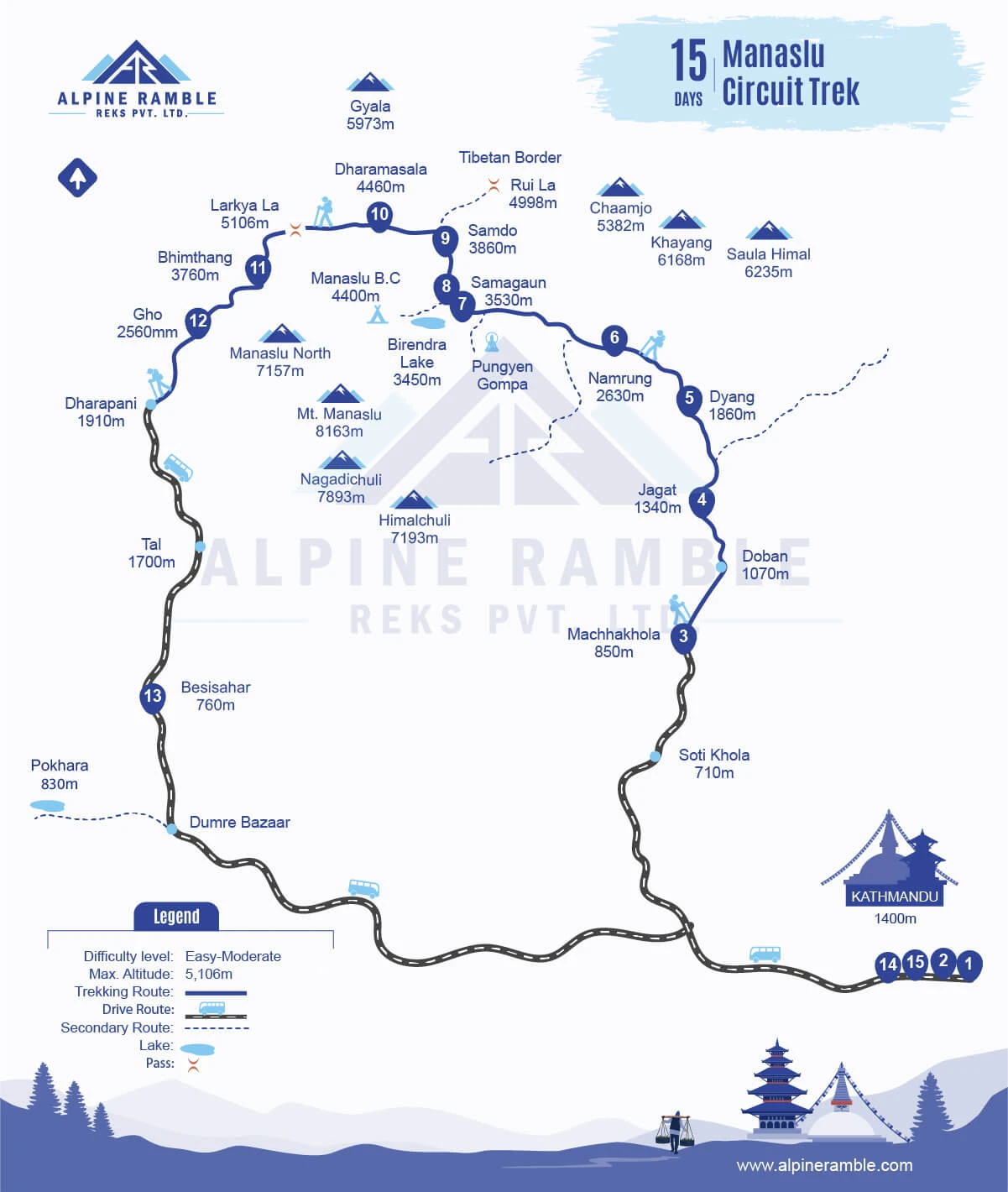
Route Map & Elevation

Manaslu Circuit Trek 12 Days
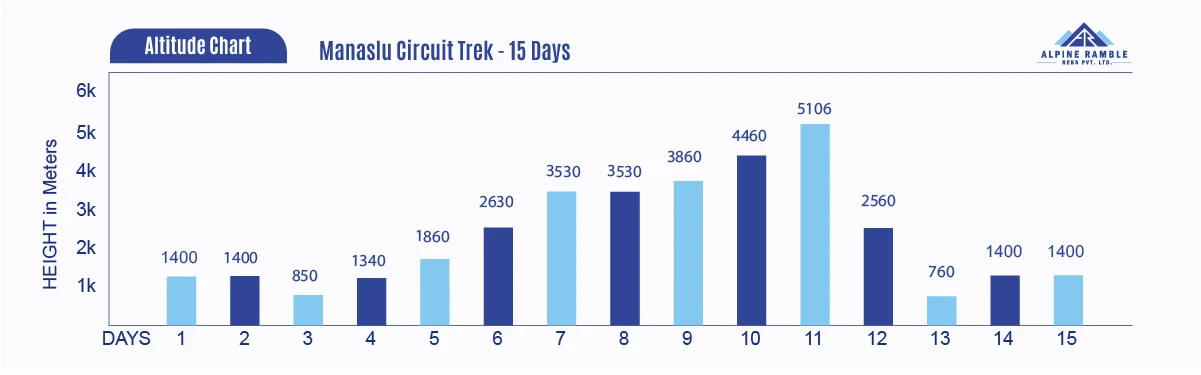
Altitude Chart
Manaslu Circuit Trek 12 Days
Cost Details

Manaslu Circuit Trek 12 Days Cost Details

Includes

  • International Airport-Hotel-Airport pickup and drop-off by private car/Jeep/Hiace.
  • Meals on a full-board basis (breakfast, lunch, and dinner/the main course) during the trek in the mountains.
  • Alpine Ramble’s experienced, government-licensed, English-speaking trekking guide.
  • All salary, food, drinks, accommodation, transport, and insurance for the guide.
  • All necessary papers, including the Manaslu Conservation Area permit and TIMS card (Trekking Information Management System) fee.
  • special Manaslu permits 
  • Trekking equipment, such as the sleeping bag and down jacket on request (optional)
  • Trekking lodges (tea houses) throughout the trek 
  • Assistant guide for the group 8 or above
  • Kathmandu to Soti Khola, Besisahar to Kathmandu by bus
  • Supplementary snacks: energy bars, crackers, cookies, etc.
  • Seasonal fresh fruit dessert every evening after dinner.
  • Appreciation of the certificate after the successful trek.
  • Farewell Dinner at a typical Nepalese restaurant with traditional music and dance
  • Alpine Ramble’s complimentary free T-shirt/route map and a duffel bag (if required)
  • An oximeter to measure your oxygen and pulse level during the trek in the mountains is very useful for all the trekkers to be aware of the high-altitude sickness.
  • Compressive first aid box (The guide will carry it throughout the trek).
  • Emergency rescue operation assistance will be arranged in case of complex health conditions (funded by your travel insurance).
  • All government, local taxes/VAT, and official Expenses

Excludes

  • Nepal entry visa fees (you can easily issue the visa on arrival at Tribhuwan International Airport, Kathmandu). $25 USD for a 15-day visa.
  • Extra accommodation and meals behind schedule (Foods and accommodations before or after the trek) & porter ($144 each for a sharing porter for two trekkers—20 kg mag in combined weight) 
  • Extra drinks, both alcoholic & non-alcoholic, such as Fanta, Coca-Cola, Sprite, water, beer, etc. 
  • Additional costs are out of management control due to the landscape, weather conditions, illness, change of government policies, strikes, physical conditions, etc.
  • Personal expenses such as snacks, laundry, telephone, WIFI, hot shower, etc at tea houses on a trek.
  • Travel insurance has to cover emergency rescue evacuation from high altitudes. 
  • Personal trekking equipment for this trek 
  • Tips for guide and sherpa if you hired one (recommended by culture)
  • Any other expenses that are not mentioned in the Price Includes section of this trek
Departures

Manaslu Circuit Trek 12 Days Dates and Price

Private Trip
Select your preferred date
Mar 2026
Apr 2026
May 2026
Jun 2026
Jul 2026
Aug 2026
Sep 2026
Oct 2026
Nov 2026
Dec 2026
Jan 2027
Feb 2027
Departure Date
31
Mar
11
Apr
Price
US$990US$1290
Save US$300
Trip Status
Guaranteed

Check our available trip departure dates and costs for the Manaslu Circuit Trek. However, the set start dates listed are particularly quoted for the group joining opportunity. If the list is not suitable for you and you want to customize this trip, please feel free to contact us for a customized departure date. Meanwhile, private trips are available on any date of your choice that suits you at any time of the year at your convenience. Get in touch for your private trip and date as you prefer.

Must-Know

Essential Information

What's inside The Short Manaslu Circuit Trek Version

The first thing to understand is simple. The 12 days Manaslu Circuit is not a lighter version of the trek. It is the more concentrated version.

You still walk the full circuit. You still move from the humid lower valley of the Budhi Gandaki to the Tibetan-influenced high settlements of Samagaon and Samdo. You still cross Larkya La Pass, and you still descend into the Annapurna region. What changes is not the substance of the journey, but the margin around it.

A longer 15 days Manaslu Circuit Trek gives you more breathing room. It usually means a gentler walking rhythm, more time to linger in villages, more flexibility for weather, and more space for side hikes or slower acclimatization.

The 12 days version asks more of you each day. It is built for travelers who are fit, prepared, and clear about why they are here.

That is its strength.

It gives you the full Manaslu story in a sharper form.


What You Gain and What You Trade Off in 12 Days

A serious traveler deserves clarity here.

With the 12 days Manaslu Circuit Trek, you gain a route that is compact, efficient, and deeply rewarding for people who do not want to spend extra days softening an experience that is already complete in its essentials.

What you gain:

  • the full circuit around Mount Manaslu

  • the crossing of Larkya La Pass

  • the cultural transition from Hindu middle hills to Tibetan Buddhist highlands

  • a quieter route than Everest Base Camp or most Annapurna sections

  • a serious high Himalayan trek within a limited time window

What you trade away:

  • fewer buffer days

  • less time for side excursions such as longer exploration around Samagaon or a more relaxed day near Birendra Lake

  • less flexibility if your body adapts slowly to altitude

  • a more demanding rhythm from the very beginning

This is why the 12 days version has its own identity. It is not a reduced route. It is a more disciplined one.


Why Manaslu Still Feels Real

The Manaslu region was opened to foreign trekkers only in 1991. That late opening matters more than most people realize.

By then, Annapurna had already become one of Nepal’s classic trekking regions, and Everest Base Camp had long entered the global trekking imagination.Manaslu arrived later, and under tighter protection. Because it remained a restricted area, it avoided the kind of tourism saturation that changes not only trails, but the emotional atmosphere of a place.

That is why Manaslu still feels different.

Not empty. Not unknown. But intact.

There are still long stretches where the trail feels governed by the river, the cliffs, the monasteries, and the weather rather than by visitor demand.Villages such as Namrung, Lho, Samagaon, and Samdo still feel like settlements first and trekking stops second.

For many travelers, that difference is the whole point.


A Sanctuary of Wildlife and Wilderness

Protected within the Manaslu Conservation Area, this landscape shelters creatures that are rarely seen but constantly present in the ecological logic of the mountains.

These slopes and forests support

  • snow leopard habitat

  • Himalayan tahr

  • blue sheep

  • musk deer

  • red panda habitat in lower forest belts

  • Himalayan monal

  • golden eagle

  • lammergeier

The important thing is not simply that these species exist here. It is that the land still belongs to them in a way that feels believable when you walk through it.

You are not moving through a scenic park shaped for human recreation. You are moving through a living mountain system where human passage remains conditional.

That is one reason Manaslu feels wilder than many more famous routes.


More Than a Mountain Trek

The Manaslu Circuit Trek 12 Days is often described as a mountain trek, but that description is too narrow.

It is a route through an entire Himalayan system.

Here you experience

  • one of Nepal’s deepest river corridors, carved by the Budhi Gandaki

  • high valleys shaped by centuries of trade with Tibet

  • glacial lakes such as Birendra Lake

  • monasteries such as Pungyen Gompa

  • yak pastures and wind-exposed high settlements

  • a true pass crossing above 5,000 meters

  • a descent into the greener, softer landscape of the Annapurna side

That range is what gives the journey its unusual completeness.

You are not simply going to one famous viewpoint and returning. You are entering a world, crossing it, and exiting somewhere changed.


A Cultural Continuum, Not a Cultural Performance

Very few treks allow you to feel culture changing around you so gradually and so clearly.

The lower sections reflect the Sanatan and Hindu traditions of Nepal’s middle hills. Agricultural terraces, roadside shrines, and settlement patterns belong to a long hill civilization tied to rivers, farming seasons, and temple life.

As you gain altitude, the atmosphere shifts. Prayer flags replace temple bells. Mani walls begin to line the trail. Stone houses become flatter and more compact. Monasteries move closer to the center of communal life. The upper valley, especially around Lho, Samagaon, and Samdo, reflects centuries of Tibetan influence and migration, especially between the 16th and 18th centuries.

This is not museum culture. It is not staged for visitors. It is still the ordinary structure of life.

You notice it in architecture, in food, in the rhythm of fields and livestock, in the movement of yaks, in the soundscape of monasteries, and in the quiet confidence of people who do not need to explain their world for it to be real.


Food, Shelter, and the Human Side of Trek in Manaslu 

A compact Manaslu itinerary is physically demanding, but one of the quiet strengths of the trek is that the human world along the route remains warm.

Teahouses offer what matters most at altitude

  • hot food

  • warm drinks

  • shelter from wind and cold

  • simple beds

  • shared dining rooms where the day slows down

Meals are often built around the foods that make practical sense in mountain life. Dal bhat, potatoes, noodles, soups, Tibetan bread, yak dairy in some areas, and seasonal local produce all reflect a culture that developed around endurance rather than culinary display.

This matters more than it sounds.

On a demanding trek, nourishment is never just nutritional. It becomes emotional. A bowl of soup in Dharamsala, tea in Samdo, or dinner around an iron stove in Namrung can stay in memory as strongly as any mountain view.

Nature may be harsh here. The human presence is often unexpectedly gentle.


Ecology From Jungle to Glacier

One of the most powerful things about the 12 days Manaslu Circuit is how quickly the ecological story unfolds.

In less than two weeks, you move through zones that feel as if they belong to entirely different continents.

You pass through

  • humid lower valleys with bamboo, sal, and subtropical vegetation

  • temperate forests of pine and rhododendron

  • subalpine terrain with juniper and wind-thinned vegetation

  • alpine meadows with yak grazing

  • moraine, snow, and glacial landscapes above 4,500 meters

This ecological compression is one of the route’s greatest strengths. Even on a shorter itinerary, the diversity is not reduced. In fact, the pace often makes the transitions feel even more dramatic.

One day you hear insects and river heat. A few days later you are sleeping in thin air beneath ice and rock.

Rivers That Turn a Short Manaslu Trek Into an Expedition

On Manaslu, rivers are not background scenery. They are one of the reasons the trek feels raw and serious.

The Budhi Gandaki is the great force of the lower and middle valley. Its gorge shapes the trail, the bridges, the settlements, and the soundscape of the early journey. Higher up, glacial tributaries such as Dudh Khola, Pungyen Khola, and Larkya Khola guide the route through increasingly exposed terrain.Later, the Marsyangdi marks your reentry into the broader world of the Annapurna side.

These rivers do more than beautify the route. They determine where life is possible.

They carve the trail and, in many ways, they carve the psychology of the trek too.


Lakes, Silence, and High Mountain Stillness

For many travelers, the lakes of the route create some of the most memorable moments of stillness.

Birendra Lake, near Samagaon, sits beneath Manaslu’s glacier at around 3,691 m. Its turquoise color comes from suspended glacial particles, but what many people remember most is not the color. It is the silence.

At that altitude, sound behaves differently. Wind, ice movement, water, and distant voices can feel magnified. In both Himalayan Buddhist thought and older contemplative traditions, still water is often associated with clarity, emptiness, and inward quiet.

Even travelers who do not think of themselves as spiritual often lower their voice near these lakes without knowing why.

That response is part of the place.


How This 12-Days Manaslu Trek Compares With Annapurna Circuit

A lot of travelers compare the Manaslu Circuit 12 days with a 12 day Annapurna Circuit Trek, and the comparison is fair, but the feeling of the routes is different.

Annapurna is more accessible. It has more infrastructure, more road contact, more accommodation options, and usually a lower operating cost. That is why 12 days Annapurna packages are often cheaper.

Manaslu asks more in permits, regulation, guide requirements, and logistics. But what you receive in return is a more self-contained mountain world, fewer crowds, and a route that still feels protected from overexposure.

If Annapurna feels classic, social, and broad in its appeal, Manaslu feels more reserved and more intact.

Neither is better for everyone.

But for travelers who value quiet, restricted-area atmosphere, and a stronger sense of wilderness, Manaslu often leaves the deeper mark.


How It Compares With Everest Base Camp

This comparison is also important because many people choosing Manaslu are really deciding between these two experiences.

Everest Base Camp gives you one of the most recognizable destinations in the world. It carries symbolic power. It has Sherpa culture, iconic lodges, and the emotional draw of moving toward the base of the highest mountain on Earth.

But it is an out and back route.

Manaslu gives you something different. It gives you a full circuit. A changing journey. A passage through multiple ecological and cultural zones rather than a single destination and return.

Everest is iconic.
Manaslu is immersive.

That difference matters especially for travelers who care about the shape of the whole experience, not only the name of the endpoint.


How Short Manaslu Circuit Feels Compared With Western Treks

Travelers from Europe, North America, Australia, and Japan often compare Manaslu with trails they already know, routes such as the Tour du Mont Blanc or other classic long-distance mountain walks.

The distance may feel familiar. The structure of moving lodge to lodge may feel partly familiar too.

But the emotional reality is different.

Western mountain treks often unfold through highly organized recreation landscapes, with denser rescue systems, easier access, stronger infrastructure, and a mountain culture already deeply shaped by outdoor tourism.

Manaslu does not feel like that.

Villages are not there because trekkers need stopping points. They are there because people live there. The route exists because geography, trade, and survival shaped it over centuries. That changes the feel of every day.

A Western trek may feel polished and beautifully maintained.
Manaslu feels more elemental.


Cost Perspective for the Short Manaslu Trek

The 12 days Manaslu Circuit tour package is usually not the cheapest major trek in Nepal, and that is understandable.

Compared with a 12 days Annapurna Circuit, Manaslu often costs more because it requires

  • restricted area permits

  • licensed guide support

  • tighter logistics in a more controlled region

  • more complex operating conditions

Compared with Everest Base Camp, Manaslu may be similar in total land cost depending on services, but often avoids some of the flight dependency and congestion associated with the Everest route.

Compared with many guided treks in Western countries, Manaslu often remains far more cost-efficient for the level of altitude, remoteness, and cultural depth it offers.

So the best way to understand the value is not by asking whether it is the cheapest.

It is better understood as one of the most complete mountain journeys available in under two weeks.


Safety, Acclimatization, and Why the 12 Days Version Demands Respect

Because this is a shorter schedule, the safety layer becomes even more important.

The 12 days itinerary still works because it preserves the essentials that cannot be skipped, especially the acclimatization stop at Samagaon. Above 3,500 meters, pace, hydration, sleep, nutrition, and guide judgment matter more than enthusiasm.

That is where experience becomes practical rather than promotional.

A well-run 12 days Manaslu trek depends on disciplined pacing, realistic observation of symptoms, and a team that understands both the physiology of altitude and the real behavior of the trail in remote terrain.

This is where Alpine Ramble Treks matters.


Why Trekking With Alpine Ramble Treks Changes the Experience

On a trek like this, a good operator does not improve the route by making it artificial. A good operator improves it by reducing avoidable friction.

With Alpine Ramble Treks, that means

  • permit handling

  • arrival and departure coordination

  • accommodation planning

  • acclimatization management

  • local guide judgment

  • emergency awareness

  • cultural interpretation without over-talking the journey

The company’s experience, local relationships, and long track record matter more on a compact trek than on a slower one, because a tighter schedule gives less room for weak organization.

The goal is not to turn the trek into a packaged performance.

The goal is to let the route remain real while making sure you can move through it safely and well.


Who the 12 Days Manaslu Circuit Is Really For

This version works best for travelers who are physically ready and mentally clear about why they are here.

It is especially well suited for

  • experienced trekkers

  • fit travelers with limited time

  • professionals who cannot take a longer leave

  • repeat visitors to Nepal

  • photographers and naturalists

  • solo travelers who want reflection with structure

  • small groups looking for a serious shared challenge

  • spiritually curious travelers who respond to silence, scale, and living mountain culture

It is less suitable for travelers looking for leisure pacing, highly cushioned comfort, or a very beginner-friendly first trek.

This route does not demand heroism. It asks for readiness.


The 12 Days Identity in One Clear Idea

The longer version says, take your time.
The 12 days version says, be ready.

That is the real difference.

And for the right traveler, that is exactly what makes it unforgettable.

Short Manaslu Circuit Trek in 60 seconds

The Manaslu Circuit Trek 12 Days is not just a compressed itinerary. It is a distinct way of experiencing one of the last truly immersive mountain circuits in the Himalaya.

You begin in Kathmandu, move into a valley opened to trekkers only in 1991, follow rivers born from glaciers, walk through villages shaped by Sanatan tradition and Tibetan Buddhism, cross one of Nepal’s great high passes, and descend into a different ecological and cultural world on the Annapurna side.

What makes it special is not only that it fits into twelve days.

It is that even within twelve days, it still feels vast.

Trip FAQs

Manaslu Circuit Trek 12 Days FAQs

Yes, you do require a VISA to enter Nepal. You can get a visa on arrival at the Tribhuvan International Airport or apply beforehand online. You will require a valid passport for at least six months beyond your intended stay in Nepal. Indian citizens do not require visas, and Chinese citizens require visas but can get them for free. For more information regarding your country, you can visit the immigration website of Nepal.

Manaslu Restricted Area Permit (MRAP)

Manaslu Conservation Area Project (MCAP) Permit

Annapurna Conservation Area Project (ACAP) Permit (if your trek extends into the Annapurna region)

No, solo trekking or going independently on the trails of the Manaslu Circuit is not allowed. It is mandatory to hire a licensed trekking guide through a registered trekking company for this trek. The rule was implemented by the government for the safety of trekkers and the conservation of the protected area.

The difficulty level of the Manaslu Circuit Trek can be described as the range of moderately challenging to difficult. While the difficulty of this trek is a subjective matter, you are required to attain a good level of physical and mental fitness to comfortably complete this journey. Training exercises and mental preparation are extremely crucial, while prior trekking experience isn’t a requirement, but it certainly will be beneficial.

Having well-functioning gear and equipment is the most important thing during any outdoor activity, especially when trekking to the mountains. Making a well-coordinated packing list for the trek will save you the hassle of guessing if you have everything you need or, worse, forgetting an essential item during the trek. You will require items like sturdy hiking boots, warm layers (fleece, down jacket), waterproof and windproof outerwear, trekking poles, a comfortable backpack, a sleeping bag (rated for cold temperatures), a headlamp, sunscreen, sunglasses, a water bottle or hydration pack, and basic first-aid supplies.

Yes, travel insurance is required to do any trek in Nepal. The insurance should cover the medical and accidental emergencies along with emergency mountain rescue at at least 6000 meters altitude.

The starting point for the Manaslu Circuit Trek is either Soti Khola or Machha Khola, based on your itinerary. And you can get there by two options: a public bus or a private jeep from Kathmandu. Alpine Ramble makes transportation arrangements for your journey.

The accommodation throughout the Manaslu Circuit trekking trail comes in the form of a local teahouse. The facilities are basic, with rooms with twin-sharing beds and a common bathroom. The higher you ascend, the more basic the accommodation facilities get.

The meals served during the Manaslu Circuit Trek range from local Nepalese dishes to some limited ranges of Western options. The local food are usually dal bhat (rice, lentils, and vegetables), noodles, momo (dumplings), Tibetan bread, etc., while the western food consists of options like Pizza, Pasta, Spaghetti, pancakes, etc.

Yes, normal tap drinking water is readily available on the trek. However, bottled mineral water or hot water costs an extra charge, while the regular tap water is free. So, it is better to carry a portable water filter or water purifying tablets for safe drinking water.

The highest elevation or point to be reached on the Manaslu Circuit Trek is the reputable Larkya La Pass, which sits at an elevation of approximately 5,106 meters (16,752 feet) above sea level.

While you surely can carry prescribed medications to avoid altitude sickness, the best way to manage it would be ascending gradually and doing acclimatization. Trek high, sleep low is a classic way to effectively reduce the chances of getting altitude sickness. During the Manaslu Circuit Trek, you will spend an extra day at the same place as a part of the acclimatization process. And make sure to eat a proper balanced diet and hydrate during the trek.

For the most part, yes, there will be electricity to charge your devices. However, you must pay a certain sum of money to charge your devices. Also, be aware the electricity can be unreliable, especially at higher elevations. So, it is recommended you carry a power bank during your trek.

Yes, there is internet or phone connectivity on the trek but it is very limited and unreliable. The lower region of the trek is able to provide some wifi access or you can buy an internet data pack on your local sim card but as you ascend to higher elevations, both the wifi and phone connection will be limited.

The currency of Nepal is Nepalese Rupees (NPR). The amount of money you should bring is something subjective and mostly depends on your own spending habits. After you have paid for the trekking package, it will cover your road transportation, three meals a day, and accommodation. So, any amount you spend will be on your personal splurging. Thus, you can calculate the amount you want to spend per day and make the budget. 

All the locations only accept Nepalese currency, so make sure to exchange money before the trek. You can withdraw money from an ATM anywhere in Kathmandu Valley but are not available once you’re on the trekking trail.

Tipping the guides and porters who have worked day and night to accommodate you and made your trek successful is a customary act and is expected. It is recommended to tip at the very end of the trek and to tip them at least 20 percent of the trek package cost. Apart from tips, acknowledging their work via small gestures like thank yous and a handshake also goes a long way.

Yes, the Manaslu Circuit is generally considered to be safe, but one does need to be aware of potential risks such as altitude sickness, rough trails, the physical demand of trekking for at least a minimum of 6 hours a day, and unpredictable weather. The best way to remain safe during the trek is to have a licensed trekking guide with you and trust the guide’s judgment. 

While meat is something you can definitely get during the Manaslu Circuit Trek, it primarily might be yak meat. However, it is not recommended you indulge in them for various reasons. One of them being hygiene issues, which in turn can cause you to get sick. So it is better not to take any chances and instead eat primarily vegetarian diets, which are thoroughly cooked and delicious. It is not only safe but also delicious, which gives you all the energy required for hours of hiking every day.

The porter can carry anywhere from 25 to 30 kilograms of weight. There are regulations and ethical guidelines that should be adhered to, which is why efficient packing must be done. Porters are the backbone of trekking and mountaineering, so being respectful to them as a company and as a client is implied and expected.

Showers are available in the lower regions of the trekking trail and hot showers cost extra money. But just like any other facilities, the higher you ascend, the fewer chances there are of getting them. The teahouses at higher altitudes do not offer showers; however, they can offer you a bucket of hot water for a shower. So, you should consider showering only if you have to during the trek. It is normal to go without showering for a few days during the trek.

The best time to do the Manaslu Circuit Trek is spring (March-May) and autumn (September-November). These two seasons provide the best views with clear skies, pleasant weather, and moderate temperatures. 

The monsoon season (June-August) gets heavy rainfall, which makes traveling a bit of a risk due to landslides in many parts of Nepal. The winter season (December-February) can be a good time to trek due to clear weather and stunning views, but you must be prepared for the extreme cold and snow. Both monsoon and winter are trekkable but only with good preparation and the chances of delays and cancellations are always high.

The Manaslu Circuit Trek is not allowed without a guide, so you will automatically be assigned one by the company you choose. With Alpine Ramble, you are guaranteed to be assisted by the most experienced licensed guide in the industry.

Yes, you can absolutely add extra days as a part of the acclimatization process. In fact, it is highly recommended to do so because adding an extra day reduces your chances of getting altitude sickness and helps you complete your trek instead of cancellation or, even worse, emergency evacuation. If you wish to add an extra day, you should consult with your guide, who will take the required measures to assist you. There might be an additional cost associated with extra days.

Dil Gurung
Speak to an Expert+977 9851175531
Dil Gurung

Words from ART Clients

Wonderful Company

This is the 2nd tour I’ve done with Alpine Ramble and I couldn’t be happier with AR. The first time, I completed the EBC trek. This year I completed the...

read more +
R
Verified
Russell W - United States
March 09, 2026

Video Reviews

A trip of a lifetime (Everest base camp trek) | Client Review | Alpine Ramble Treks

A trip of a lifetime (Everest base camp trek) | Client Review | Alpine Ramble Treks

Dan and Loiuse - Australia
Alpine Ramble Treks Client Review

Alpine Ramble Treks Client Review

Cherry - United States
Need Help? Call Us+977 9813593530