What the Tsum Valley Trek Actually Is
Not a circuit. Not a summit approach. Not a crowded highway of trekkers.
The Tsum Valley Trek is a journey into one of the last intact Himalayan cultural landscapes , a side valley branching north from the Budhi Gandaki gorge, close to the Tibetan Plateau. Unlike the Everest or Annapurna regions, where tourism reshaped daily life decades ago, Tsum remained largely closed to outsiders until 2008.
Even today, entry requires a restricted-area permit and a licensed guide. Solo trekking is not allowed. This regulation did not exist to make travel difficult; it exists because the valley holds ecological, cultural, and spiritual significance considered worth protecting.
“Tsum” is widely understood to derive from the Tibetan word “Tsombo,” meaning vivid or bright, but the valley is more deeply known as a Beyul — a sacred hidden land in Tibetan Buddhist tradition, believed to have been blessed by Guru Rinpoche (Padmasambhava) in the 8th century as a refuge for spiritual practitioners during times of turmoil.
This is why the trek feels different from the moment you leave the main Manaslu trail at Lokpa. You are not just heading into higher terrain. You are entering a different cultural world.
Geographic Setting: Where Tsum Valley Exists
The valley lies entirely within the Manaslu Conservation Area, established in 1998, in Nepal’s Gorkha District — historically significant as the homeland of King Prithvi Narayan Shah, who unified modern Nepal in the 18th century.
Administratively, most of the upper valley falls under Chum Nubri Rural Municipality, one of Nepal’s highest inhabited administrative units.
| Geographic Feature | Details |
|---|---|
| Region | Manaslu Conservation Area, Gorkha District |
| Administrative Unit | Chum Nubri Rural Municipality |
| Opening to Trekkers | 2008 |
| Highest Elevation (Typical Trek) | ~4,200 m (Ganesh Himal Base Camp area) |
| Lowest Elevation | ~710 m (Soti Khola) |
| Main River | Budhi Gandaki River |
| Border Proximity | Close to Tibet Autonomous Region (China) |
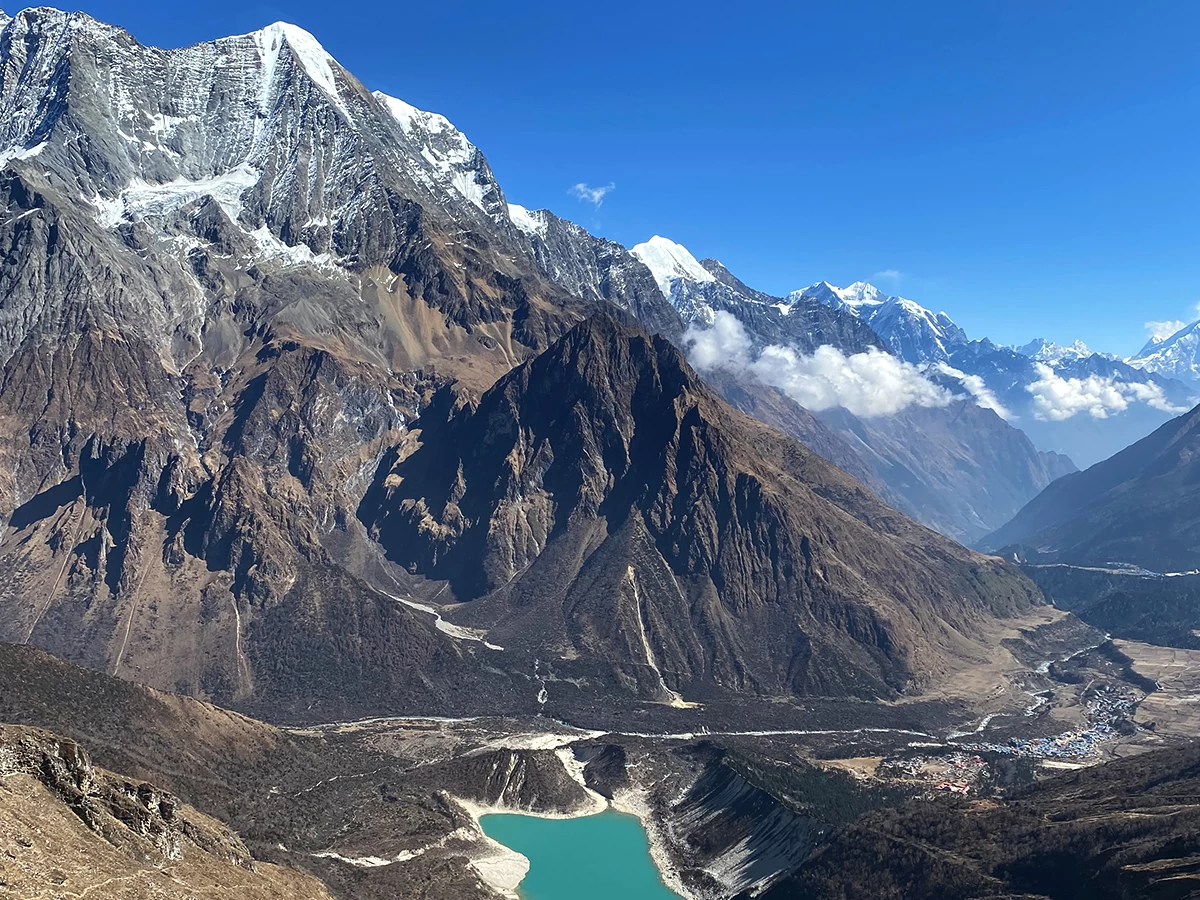
The valley runs roughly south–north from subtropical hills into high Himalayan terrain beneath the Ganesh Himal massif.
The River That Guides the Journey: Budhi Gandaki
Your entire approach follows the Budhi Gandaki River — a glacier-fed system originating near Manaslu’s icefields.
The name “Gandaki” carries deep spiritual weight in South Asia. Rivers of this system are associated with purification and pilgrimage, and black ammonite fossils found in some Gandaki tributaries are revered as sacred stones in Hindu tradition.
Geologically, the river carved a steep gorge that dictated settlement patterns. Villages sit where land allows farming. Trails cling to cliffs or cross via suspension bridges. The sound of moving water is a constant companion for days.
Origins of Major Villages Along the Route
Soti Khola (≈710 m)
The trek’s road-access starting point. “Khola” means river. Soti likely derives from local settlement names rather than a single linguistic root. Historically a trading stop between hill communities.
Machha Khola (≈870 m)
Literally “Fish River.” Named for abundant fish in local streams. This is where many trekkers feel the first real shift from road travel to foot travel.
Jagat (≈1,340 m)
A traditional customs checkpoint on historic trade routes between Nepal and Tibet. Today it also marks entry into the Manaslu Conservation Area, where permits are verified.
Lokpa (≈2,040 m)
The point where the trail diverges from the Manaslu Circuit into Tsum Valley. In local memory, Lokpa has long served as a gateway settlement between cultural zones.
Chumling (≈2,386 m)
Often called “Lower Tsum.” The name roughly conveys a place of settlement in the valley. From here, Tibetan cultural influence becomes unmistakable.
Chokangparo / Chekampar (≈3,010 m)
“Upper Tsum.” A cluster of traditional villages on an open plateau with extensive views of the Ganesh Himal range.
Nile (≈3,361 m)
One of the northernmost permanent settlements, close to the Tibetan border. Strong Tibetan linguistic and cultural continuity is evident here.
Mu Gompa (≈3,700 m)
The largest monastery in the valley. “Gompa” simply means monastery in Tibetan. This site has been a center of Buddhist practice for centuries.
Cultural Identity: The Tsumba People
The inhabitants of Tsum Valley are known as Tsumba, an ethnic group of Tibetan origin whose culture, language, and religious practices closely resemble those of southern Tibet.
Most follow the Nyingma school of Tibetan Buddhism, the oldest tradition in Tibetan Buddhism.
Distinctive characteristics include:
- Stone houses with flat roofs designed for snow load
- Agricultural terraces for barley and potatoes
- Yak and mule herding
- Monasteries integrated into daily life
- Strong community cohesion
Unlike many Himalayan regions, parts of Tsum historically prohibited animal slaughter due to Buddhist values. This contributes to the valley’s reputation as spiritually significant.
Spiritual and Historical Significance
Guru Rinpoche and the Concept of Beyul
According to Tibetan Buddhist tradition, Guru Rinpoche sanctified hidden valleys across the Himalayas as places of refuge for future generations. Tsum Valley is counted among these sacred landscapes.
Pilgrimage routes within the valley include caves associated with the yogi Milarepa, one of Tibet’s most revered spiritual figures from the 11th century. Milarepa is said to have meditated in caves throughout the region, leaving a legacy still honored by local communities.
Monastic Landmarks
- Mu Gompa — largest monastery in the valley
- Rachen Gompa — important nunnery
- Numerous smaller gompas, chortens, and mani walls.
These are active religious sites, not museum pieces.
Mountain System: Ganesh Himal and Surroundings
The Tsum Valley sits beneath the Ganesh Himal range, named after the Hindu deity Lord Ganesh because the profile of the mountains resembles an elephant’s head from certain viewpoints.
Major peaks visible include:
- Ganesh I (Yangra) — 7,422 m
- Ganesh II (Ganesh NW) — 7,118 m
- Ganesh III (Salasungo) — 7,043 m
- Ganesh IV (Pabil) — 7,104 m
- Sringi Himal — ~7,165 m
- Himalchuli — 7,893 m
- Boudha Himal — ~6,672 m
- Occasional distant glimpses of Manaslu — 8,163 m
Unlike Everest routes focused on one mountain, Tsum offers a broad panorama of lesser-known but equally massive peaks.
Ecology: A Vertical Transition Zone
The trek passes through multiple climatic zones compressed into a relatively short distance.
Vegetation Progression
- Subtropical forests (sal, bamboo)
- Temperate forests (oak, pine, rhododendron)
- Subalpine scrub (juniper)
- Alpine meadows
- Glacial terrain
Spring months bring extensive rhododendron blooms ; Nepal’s national flower.
Wildlife Possibilities
- Himalayan tahr
- Musk deer
- Langur monkeys
- Blue sheep (bharal)
- Himalayan monal pheasant
- Lammergeier vultures
Snow leopards inhabit remote high areas but are rarely seen.
Climate by Month
| Month Range | Typical Conditions |
|---|---|
| March–May | Mild, flowering forests, clear views |
| June–August | Monsoon rain in lower areas, landslide risk |
| September–October | Clear skies, peak trekking season |
| November | Crisp air, excellent visibility |
| December–February | Cold, snow possible above ~3,000 m |
Temperature can vary dramatically from warm subtropical conditions to sub-zero nights at higher elevations.
Why This Trek Attracts International Travelers
Different nationalities are drawn to Tsum Valley for different reasons.
United States & Canada
Desire for meaningful wilderness experiences beyond crowded iconic routes. Interest in cultural depth and authenticity.
Germany & Central Europe
Strong trekking culture and appreciation for structured long-distance journeys with historical context.
Australia & New Zealand
Adventure-oriented travelers seeking remote mountain environments distinct from their own landscapes.
Russia
Affinity for austere, high-altitude terrain and endurance travel.
Japan
Cultural connection to Buddhist heritage and respect for mountains as sacred spaces.
China & Singapore
Interest in Tibetan culture and remote landscapes not easily accessible within their own countries.
Tsum Valley Trek Cost From Home - Typical Total Trip Range (2026–2027)
Approximate full-trip costs including flights, permits, package, insurance(must), and personal expenses:
| Country | Estimated Total Cost |
|---|---|
| USA | USD 3,200–5,200 |
| Canada | CAD 4,300–6,700 |
| Germany | EUR 2,900–4,700 |
| Russia | USD 2,800–4,200 |
| Australia | AUD 4,800–7,200 |
| Japan | JPY 420,000–650,000 |
| China | CNY 20,000–32,000 |
| Singapore | SGD 3,800–5,800 |
| India | USD 1,600–2,600 |
Costs vary by flight timing, comfort level, and gear ownership.
Tsum Valley Trek Difficulty and Who This Trek Is For
The Tsum Valley Trek is generally considered moderately difficult.
Key factors:
- Daily walking 5–7 hours
- Steady altitude gain
- Remote terrain
- Basic accommodation
- No technical climbing required
Suitable for:
- Fit beginners with preparation
- Experienced trekkers seeking quieter routes
- Cultural travelers interested in Tibetan Buddhism
- Photographers and researchers
- Solo travelers using guided support
Why Tsum Valley Instead of Everest or Annapurna Circuit?
Everest Base Camp: iconic but crowded and infrastructure-heavy
Annapurna Circuit: diverse but heavily road-affected in sections
Langtang: accessible but smaller geographic scope
Tsum Valley offers something increasingly rare:
A high Himalayan landscape where traditional culture, environment, and daily life remain closely interwoven , not curated for tourism, but simply continuing as they have for generations.
15-days Tsum Valley Trek in 30 seconds
The 15-days Tsum Valley Trek is a moderate-difficulty journey into a restricted Himalayan valley in Nepal’s Manaslu region, combining Tibetan Buddhist culture, remote villages, diverse ecosystems, and panoramic views of the Ganesh Himal range in one of the least altered trekking environments in the Himalayas.
Transportation Cost During the Tsum Valley Trek of 15 Days (2026/2027)
For transportation, you can either choose a local bus or hire a private jeep to reach the beginning point of the trek, which is Soti Khola, and drive back to Kathmandu after the trek ends. There are no flights connecting on this trail, so your main mode of transportation is by road. Taking the local bus will be much more affordable compared to hiring a private jeep.
Cost of Transportation on Different Means
The approximate costs of transportation during the 15 days of the Tsum Valley Trek are as follows.
- Local Bus: $15-$20 per person.
- Private Jeep: $250-$300 per jeep