Therefore, having a good knowledge of how the weather and climate work on the trail is important. Packing only for a single condition is bound to make you suffer through the other extreme conditions. Packing too much or too little and packing the wrong type of gear and equipment can not only make the trekking experience miserable but is also a health and safety risk.
The cold weather isn’t the only variable that changes during the Manaslu Circuit Trek. There are other variables equally important to consider. So, unlike other packing lists, this blog guide is different and will provide a detailed breakdown of stage-by-stage gear requirements and an essential packing list for the Manaslu Circuit, rather than a single undifferentiated list, ensuring that nothing sits unused in your duffel and nothing critical gets left behind.
Quick Overview: Why Packing for Manaslu Is Different
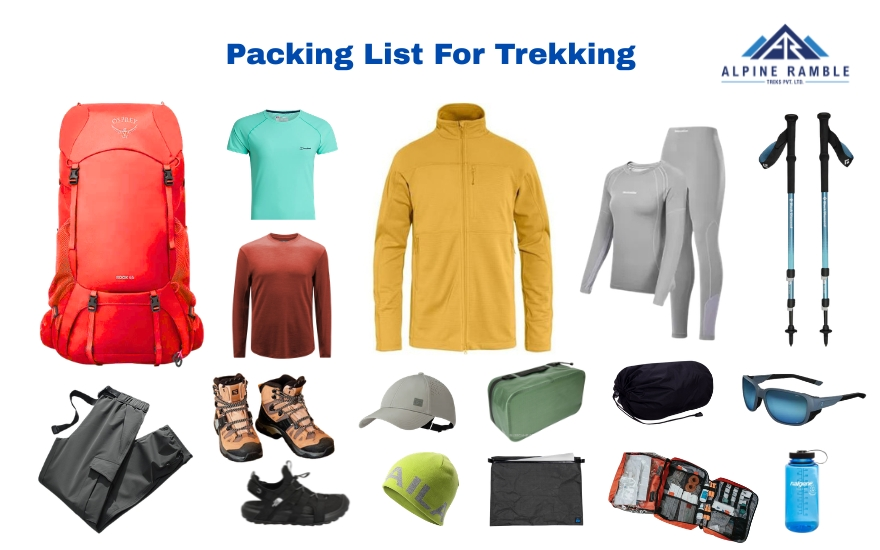
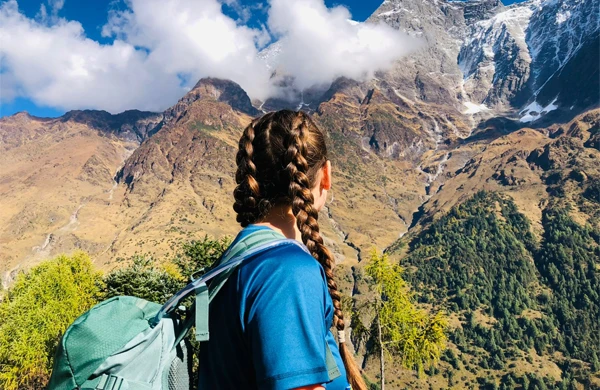
As mentioned above, packing for the Manaslu Circuit Trek isn’t just a one-dimensional approach; there are layers to everything (pun intended). Manaslu Circuit is an absolutely beautiful trek with variations of elevation from 800 meters to 5000 meters and above. This means everything you experience forms scenarios to weather that are determined by the geographic elevation.
From Machha Khola to Larkya La Pass, you need to be prepared for any type of situation this trek throws at you. You will be packing for different climatic scenarios; the first few days almost feel tropical at around 1500 meters, with only mornings and evenings being cooler. And by the time you cross the Larkya Pass, the temperature drops down to the negative. Nepal offers more gentle treks than this, but choosing the Manaslu Circuit Trek means choosing the challenging part.
All of these situations being compressed just under two weeks makes things even more critical, and one of the best ways to minimize challenges and enhance comfort is to pack the right gears for the right conditions. And unlike the destinations like the Annapurna Circuit Trek or Everest Base Camp, which offer proper lodges and teahouses, the Manaslu Circuit Trek is far more remote, and the teahouses offer only basic services.
And once you’re past the Jagat or Deng, there aren’t any shops for gears, so if you forgot a glove liner or blew a zipper on your jacket, nothing can be done until you reach lower towns. This single fact should influence almost every packing decision you make, not just what you bring, but how much redundancy you build in.
Another addition is the extra documents required because of the restricted area label. Because the Manaslu Circuit requires a restricted area permit and a licensed trekking company to guide you throughout the entire trek. Despite being a small part, it is still important and cannot be left out of the packing list, and forgetting it means your trek stops before it even starts.
Nonetheless, all of this does not mean you need dramatically advanced gear and equipment at your disposal; it just means that the reasoning behind even the smallest of the gear is different, and that reasoning is what the rest of this guide is built around, not just a list of things to buy.
Manaslu Circuit Trek Weather or Climate & Best Season: The Three Climates You'll Actually Pack For this 2026
Making a packing list based on what season it is is kind of redundant, as it gives more insight on when to do the Manaslu Circuit Trek rather than about what to pack for any given day on the trail. What actually determines your gear is where you are on the route, as you pass through distinct climatic zones in the two-week time period. Whether it is Manaslu Circuit Trek 12 days or Manaslu Circuit Trek with Tsum Valley, categorizing different zone helps to make a clear idea on what to pack without losing any essentials.
Zone 1: Subtropical Lowlands (Machha Khola to Jagat, ~800 m–1,400 m)
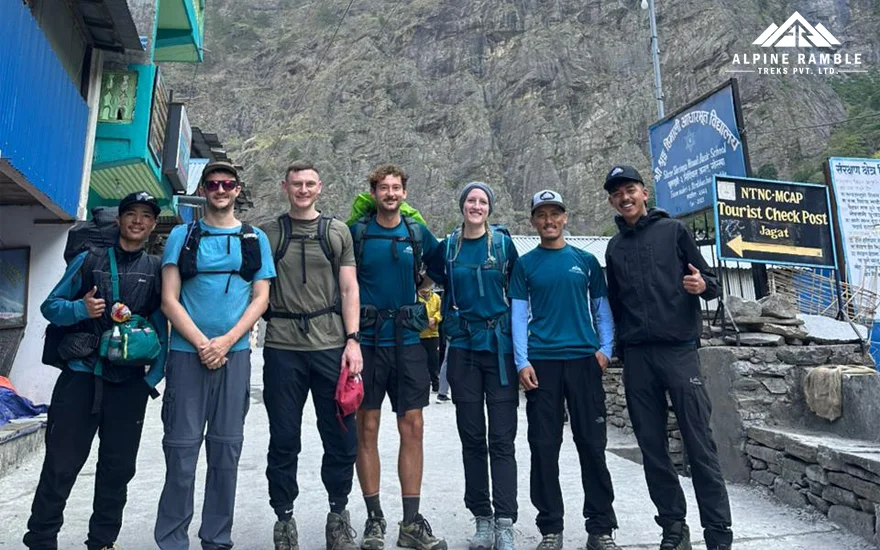
This is the lowest section of the Manaslu trail, and the conditions are so completely different from what most people believe. The trek starts around Machha Khola or Soti Khola, which is even lower elevation compared to kathmandu, which means it is actually warmer.
Here you should have light and breathable clothes instead of thick and warm ones, think sweat-through-your-shirt heat, not mountain chill. Trekkers who show up in full alpine gear on day one usually regret it by lunchtime. The average temperature for spring and autumn ranges from 10°C to 20°C (50°F to 68°F) during the daytime, dropping to around 5°C (41°F) at night, and in the winter season it will drop even lower.
What matters during this section: breathable, quick-dry clothing, sun protection, and bug repellent. Your down jacket and thermals should be buried at the bottom of your bag; they’ll be useful only a few days later.
Zone 2: Alpine Forest & Mid-Altitude Villages (Deng to Samagaon, ~1,800 m–3,500 m)
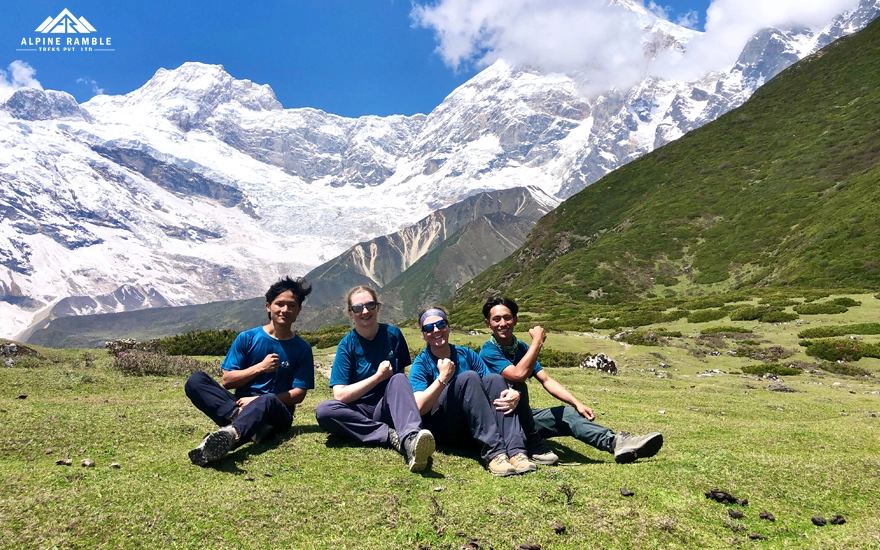
The second zone increases in elevation and is the transitioning section of this trek. The climate begins to shift as the days pass on. From subtropical lowland you move to alpine forest and mid-altitude villages. Here, the days are still warm, but mornings and evenings are noticeably colder. Rain and mist are common, especially in the forested sections.
This is the part where the layering system starts making sense: a fleece or light insulating layer goes on at rest stops, a waterproof shell comes out for afternoon showers, and you'll want warmer sleepwear at the teahouses than you needed lower down. The temperatures are moderate but cooler in autumn compared to spring, with nights beginning to approach freezing as you near the 3,500m mark.
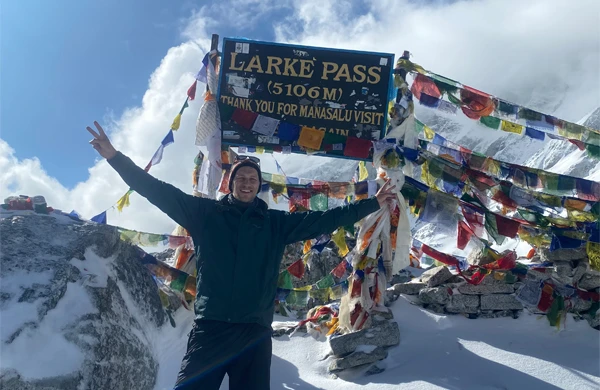
Zone 3: High Glacial Zone (Samdo to Larkya La Pass, ~3,900 m–5,106 m)
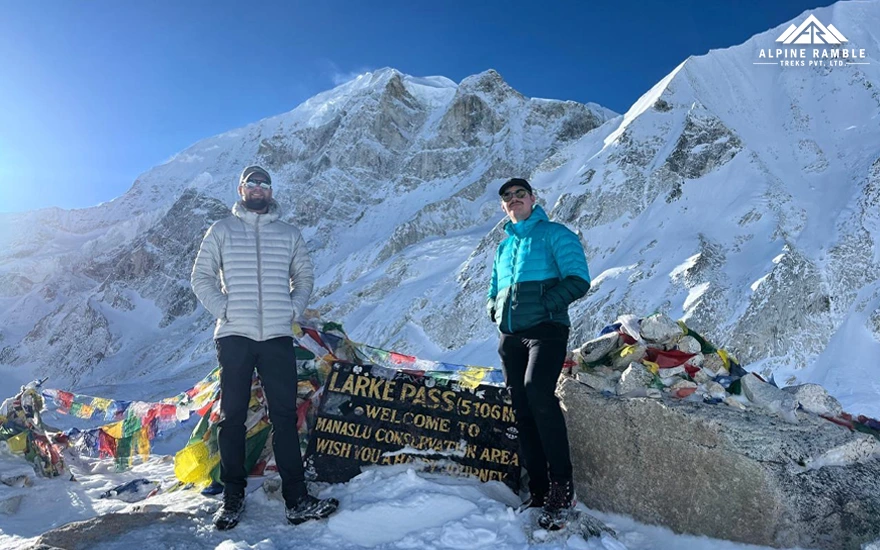
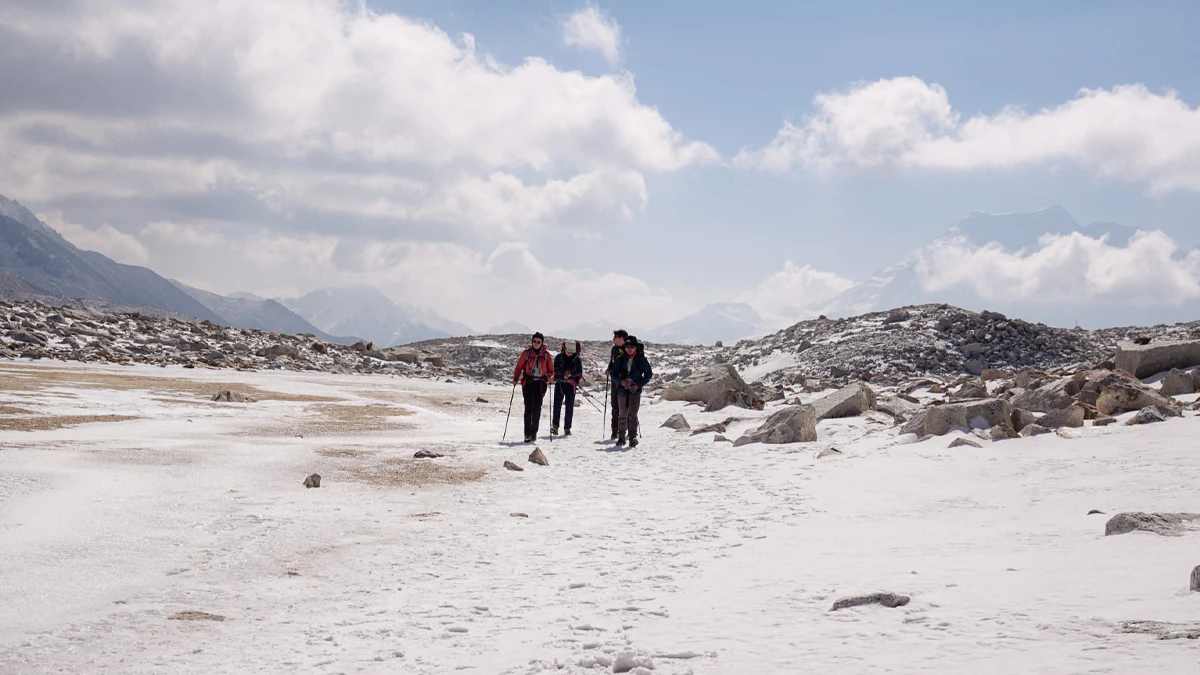
The third zone is the higher altitude, which means the temperatures drop and the coldness really comes through. From here on out, not only will the temperature drop to negative degrees, but the altitude also has more of an impact on your body. During the day it's cold along with relentless high-velocity wind, and you may be walking over snow and ice depending on the season. Oxygen is thinner, which also means your body handles cold less efficiently than it did lower down.
This is precisely where your -20-degree sleeping bag, insulated down jackets, double-layer gloves, and gaiters stop being just a weight on your backpack and actually make a big difference between a hard day and a genuinely risky one. The average daytime temperature ranges from -2°C to 5°C (28°F to 41°F), whereas the tight time is -10°C to -5°C (14°F to 23°F) in good conditions.
Why is this framing different from other packing lists?
Separating zones helps to create an actual outline map as to what gear and clothes are required for each day of the trek rather than just lumping everything on the checklist in one big requirement. This prevents treating every piece of equipment and gear as equally important and creates a tier with specific requirements assigned. For example, your sun hat is not required in zone 3, and your thick down jackets are not important in zone 1. Assigning each piece of clothing, gear, and equipment to a different zone helps you pack for the trail you'll actually be on, not a generic idea of "the Himalayas."
What nobody tells you about Packing for a Restricted Area like the Manaslu Circuit Trek
Most of the trekking destinations in Nepal are located inside of a protected area. From Sagarmatha National Park for Everest Base Camp to Annapurna Conservation Area for Annapurna Base Camp, they are all part of the protected area, and Manaslu Circuit isn’t any different. In fact, Manaslu Circuit falls within the area of the Manaslu Conservation Area, but the only difference from other protected areas is that the Manaslu Region is also a restricted area.
The label “restricted area” does impact how you pack, as the trail will not be the same when you go to Everest or Annapurna for a trek. People often mistake the Manaslu trail as the same as the Everest one, where you can buy gear in place like Namche Bazaar. There is no “I’ll just buy it there." If you forget anything, there isn’t going back, and improvising will be your best and only solution.
Aside from clothes and gear, a restricted area permit is also an important part of your packing list. In fact, Manaslu requires a restricted area permit (RAP), a Manaslu Conservation Area Permit (MACP), and an Annapurna Conservation Area Permit (ACAP) for the tail end near Dharapani. You will need physical copies, which will be checked on multiple checkpoints on the trail.
Another part is solo trekking on the Manaslu Circuit, which is not legally allowed, which means you will need a licensed guide and maybe even a porter for the trek. This means you, the porter, can carry most of your belongings, and you can carry only an important portion.
Cash is another important factor that many trekkers forget to consider. Especially when it comes to trekking the Manaslu Circuit, the area is very remote, and finding an ATM or even working an online transaction is next to impossible. Due to the restrictedness of the trail, anything you buy, from food to toilet paper, you will have to pay in cash upfront.
Most commonly made packing mistakes
While many packing lists for the Manaslu Circuit Trek mention everything, they often overlook the mistakes that many people are likely to make during the trek. Here is a list of the most common mistakes that trekkers tend to make while doing the Manaslu Circuit Trek:
- Packing for the destination instead of the whole route
- Underestimating how cold "cold" actually gets at the pass
- One pair of gloves for the entire trek
- New boots, or boots that were "broken in" on flat ground
- Overpacking toiletries and "just in case" comfort items, then running out of duffel weight for things that matter
- Forgetting that electronics fail faster in the cold
- Not testing gear before the trek starts
The Layering System, As a Decision Tree
Instead of making a random list of everything, think of your layering system as a series of decisions, and each is determined by which zone you’re in. There are three main layers, and each layer has its own purpose.
Base layer: Moisture Management
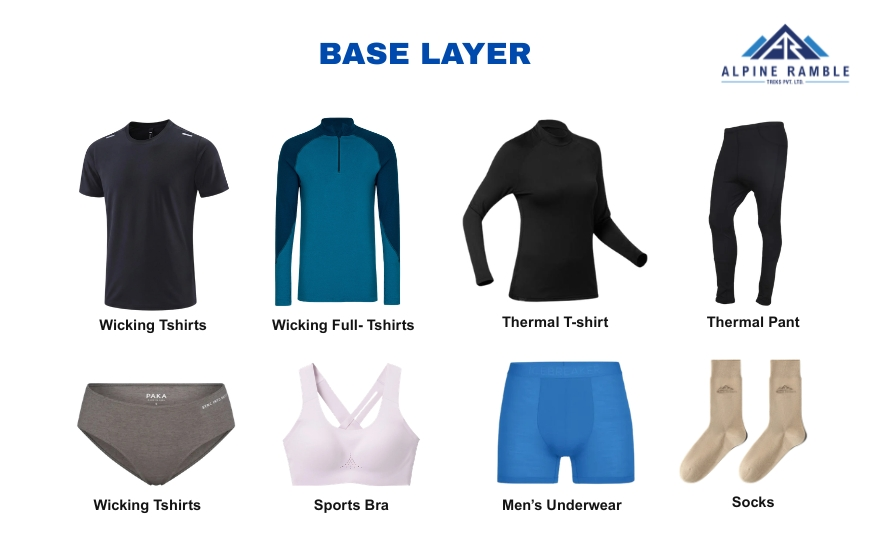
This is the first layer you put on your body. Its main purpose is to pull sweat away from your body before it cools and chills you. This is why the fabric choice matters; cotton absorbs and holds moisture, while synthetic fabrics or merino wool wick it away and dry fast. A wet base layer in Zone 3's cold is one of the fastest ways to get genuinely cold, even with good layers on top of it.
Requirements for Base Layer
Long-sleeve top, synthetic or merino wool (never cotton)
Bottoms: thermal leggings, same fabric rule
Should fit snug, not tight; trapped air is part of what keeps you warm.
You'll likely have two sets: a lighter one for Zones 1–2 and a warmer merino weight for Zone 3
Mid layer: Insulation
This layer is to trap your body heat. Fleece and down do this differently: fleece stays breathable, so it works well while you're actively hiking and generating heat; down insulates better for its weight but breathes poorly, so it's better suited to rest stops, evenings, and the coldest stretches where you're not moving much. This is also the layer you'll swap or add most often through the day, which is why carrying more than one option matters.
Requirements for Mid Layer
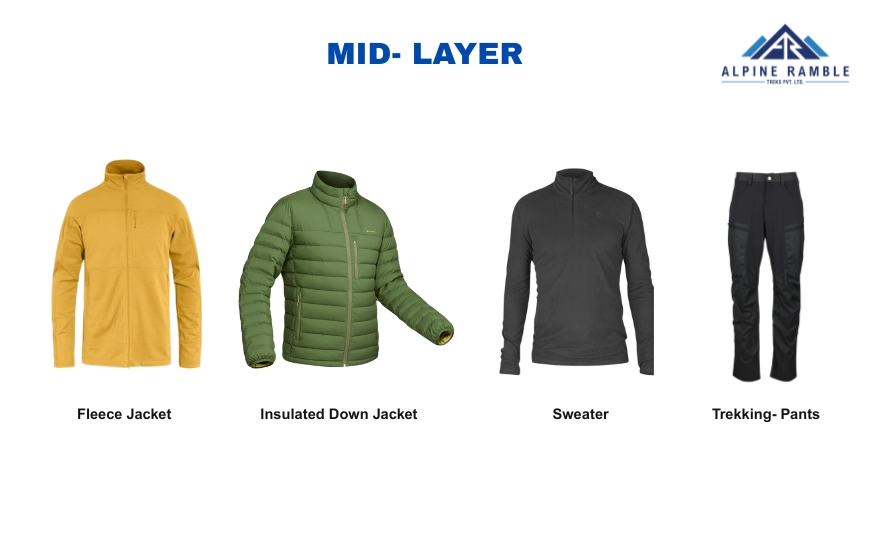
Fleece jacket, breathable, good for active hiking when you're generating heat
Insulated down jacket, better warmth-to-weight, but breathes poorly, so it's for stops, evenings, and cold ascents rather than steady walking
Most trekkers carry both and switch between them rather than picking one, fleece while moving, and down when stationary or in serious cold
Outer shell: Protection
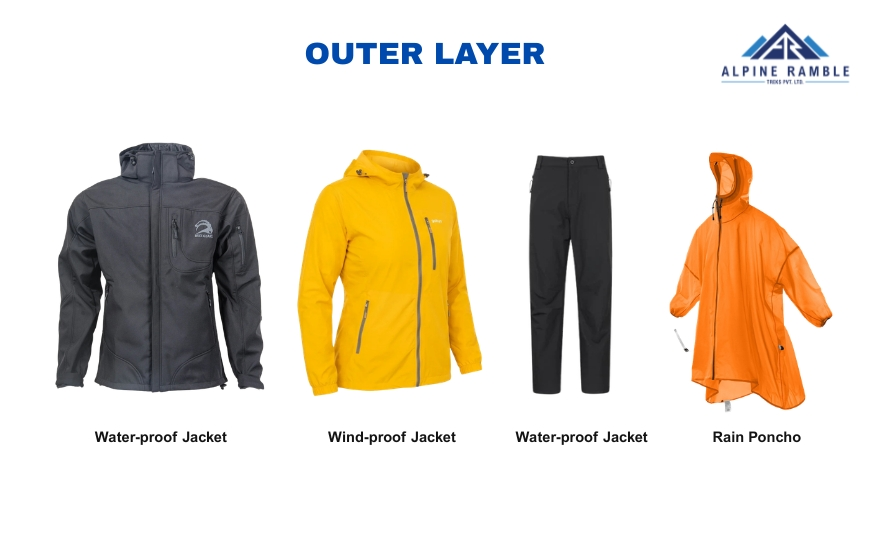
The outer layer’s job is to protect. This layer protects you against rain, wind, and snow. A shell keeps the two layers underneath doing their jobs properly; without it, wind cuts straight through insulation and rain soaks it, undoing everything the base and mid layers are doing. A genuinely waterproof-breathable shell (not just water-resistant) is worth the investment, since Zone 2's rain and Zone 3's wind are where a cheap shell tends to fail.
Requirement for Outer Layer
Waterproof, windproof, breathable shell jacket (genuine waterproof-breathable fabric, not just water-resistant)
Shell pants for wind/snow at higher altitudes, especially around Larke Pass
This layer goes on and off constantly; weather changes fast, especially in Zone 2 and above
Universal Gear List Required for the Manaslu Circuit Trek
The universal gear are those that will end up in your suitcase whether you are planning a trek to the mountains of the Manaslu Circuit or the plain lands of the Terai. These are rather important things you are most likely to pack. These are the first things that should be sorted out and of primary priority on your packing list for the Manaslu Circuit Trek, as each one asks something different of your bag.
Documents & Money to Pack
- Permits (non-negotiable, checkpoint-verified):
- Manaslu Restricted Area Permit (RAP)
- Manaslu Conservation Area Permit (MCAP)
- Annapurna Conservation Area Permit (ACAP) required for the final stretch near Dharapani
- 2–3 physical photocopies of each, kept separate from the originals
Identity documents:
- Passport (original)
- 4–6 passport-sized photos (agencies and permit offices ask for these more often than trekkers expect)
- Photocopies of your passport's photo page and visa page
Money:
- Enough Nepali rupees, in cash, for the entire trek: teahouse stays, meals, hot showers, device charging, snacks, and tips for the guide/porter.
- No ATMs and essentially no card payments past the trailhead towns, so this isn't a "top up as you go" situation.
- Small denominations matter; change is limited in teahouses.
Insurance & contacts:
- Printed travel insurance policy with the emergency/evacuation contact number visible (don't rely on having signal to pull this up on your phone)
- A copy of your itinerary and emergency contacts left with someone at home
Lower body
- Trekking pants (full-length, quick-dry, 2 pairs)
- Convertible trekking pants/shorts (for Zone 1 heat)
- Thermal leggings (base layer, for Zone 2 evenings and Zone 3 full-time)
- Waterproof/windproof shell pants
- Underwear (moisture-wicking, 5–7 pairs)
- Trekking belt (optional, adjustable for layering)
Head and hands
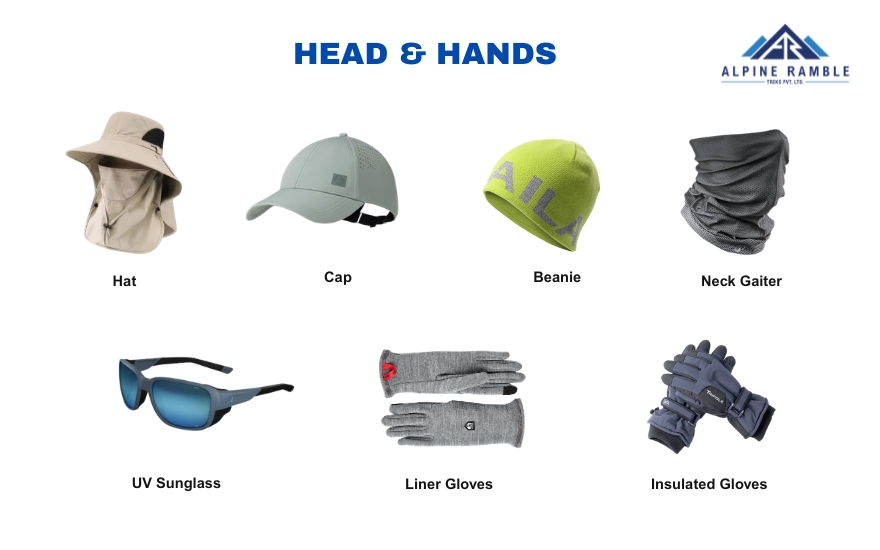
- Sun hat with brim (Zone 1)
- Warm beanie (Zone 2 onward)
- Buff or neck gaiter (sun, dust, and cold-face protection)
- Sunglasses with UV protection (glacier-rated/high UV for Zone 3 snow glare)
- Liner gloves (lightweight, worn alone in Zone 2, under shell gloves in Zone 3)
- Insulated shell gloves or mitts (Zone 3, pass day)
- Balaclava (optional, for pass-day wind chill)
Footwear: One Pair or Two?
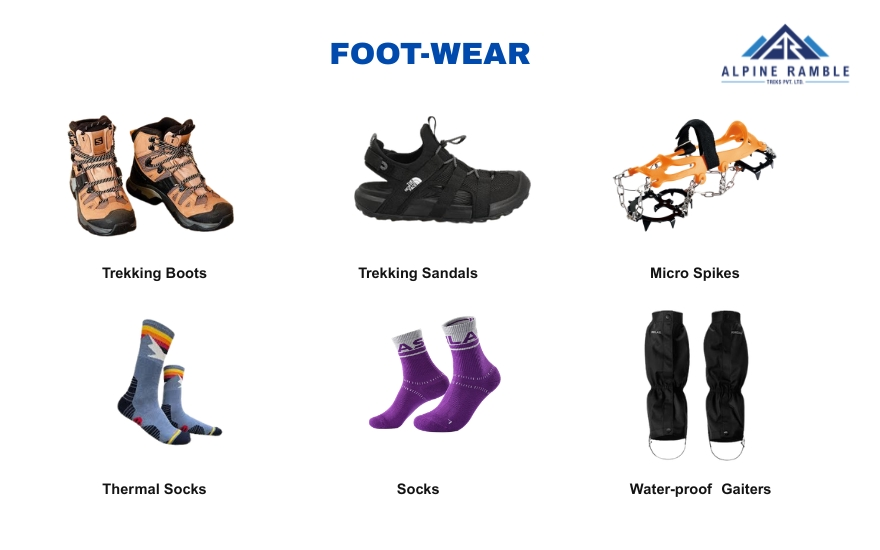
- Waterproof trekking boots (broken in well before the trek, ankle support)
- Camp shoes or lightweight sandals (for evenings at teahouses)
- Wool trekking socks (liner + thick pair, 4–5 sets)
- Liner socks (thin, worn under wool socks to reduce blisters)
- Gaiters (for snow near Samdo/Larke Pass)
- Extra pair of laces (small, easy to forget, hard to replace past Jagat)
Backpacks & Bags
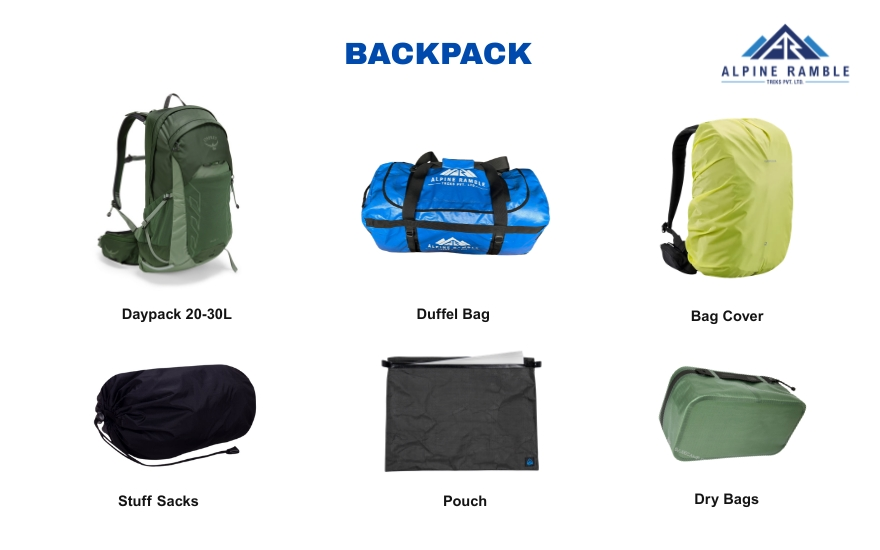
- Daypack (20–30L, carried daily)
- Porter duffel bag (80–100 L, weight-limited by agency, usually 12–15kg)
- Rain cover for daypack (and duffel, if not already waterproof)
- Dry bags or packing cubes (for clothing, electronics, and sleeping gear separation)
- Small daypack organizer or pouch for documents/permits
- Stuff sacks (for compressing sleeping bag/down jacket)
Health & Safety Items
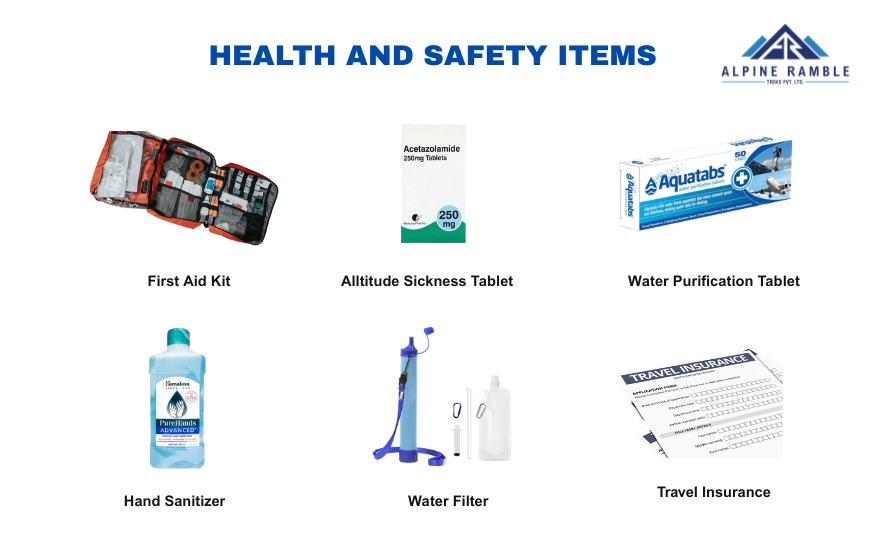
- Personal first aid kit (blister plasters/moleskin, antiseptic, plasters, gauze)
- Personal prescription medication (with buffer for delays)
- Altitude sickness medication (only as prescribed by a doctor beforehand)
- Water purification tablets, filters, or UV sterilizers
- Hand sanitizer
- Basic medical info card (blood type, allergies, emergency contact)
- Travel insurance documents (printed, with evacuation contact visible)
- Diamox or equivalent (only if prescribed: not self-administered based on internet advice)
Toiletries, Electronics & Small Essentials
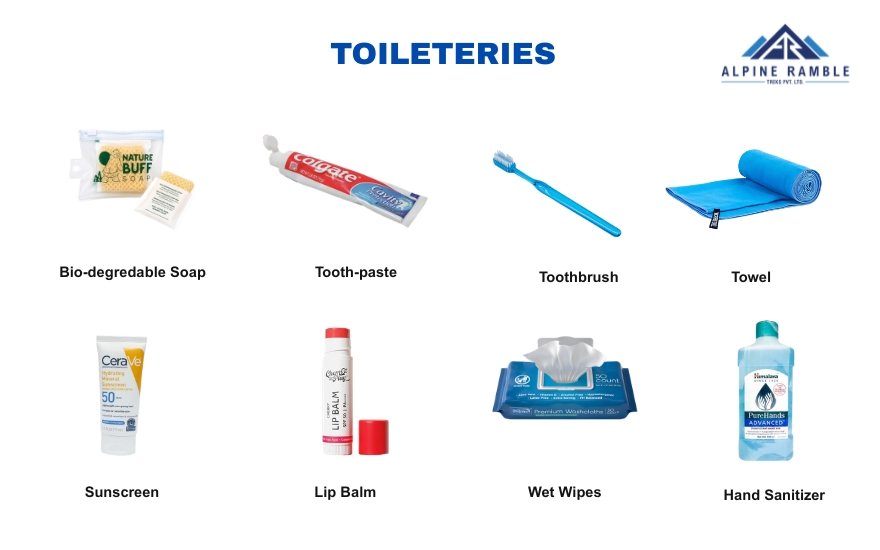
- Toiletries
- Biodegradable soap (multi-use: body, light laundry)
- Quick-dry travel towel
- Toothbrush, toothpaste, small essentials kit
- Sunscreen, SPF 50+
- Lip balm with SPF
- Wet wipes
- Toilet paper
- Hand sanitizer
- Menstrual hygiene items, if needed
Electronics
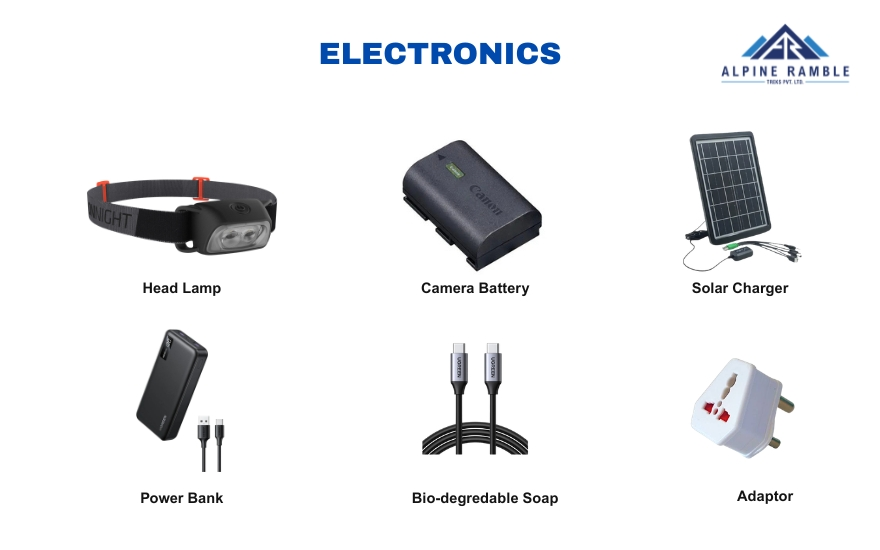
- Headlamp + spare batteries
- Power bank (higher-capacity recommended)
- Phone/camera
- Charging cable(s)
- Solar charger (optional, useful for longer stretches)
Small essentials
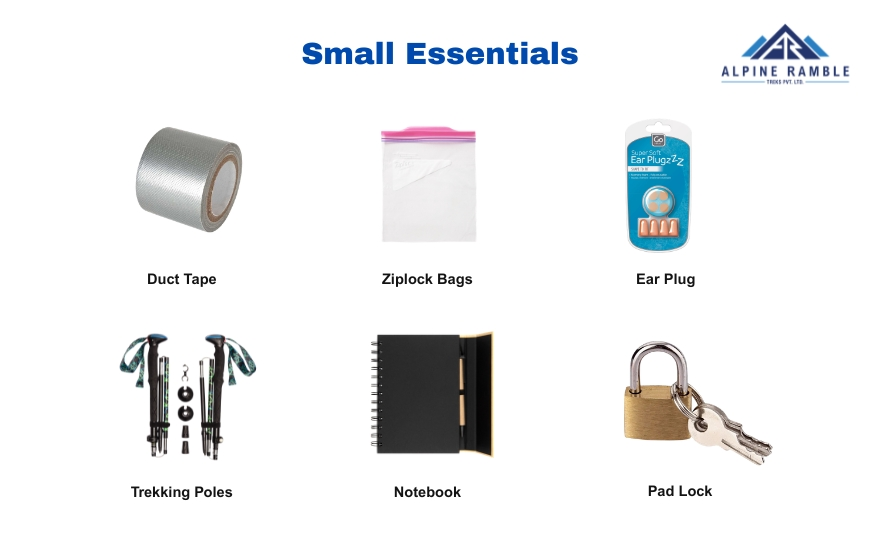
- Multi-tool
- Duct tape (wrapped around a pole or bottle to save space)
- Ziplock bags (several, various sizes)
- Earplugs
- Notebook/journal or offline entertainment
- Trekking poles
- Small padlock (for duffel security)
What NOT to Pack
You can find a lot of information on what to pack for the Manaslu Circuit Trek, but here you will also get to know what NOT to pack. Because not everything that gives you warmth or looks good should end up on your backpack. It quickly becomes a dead weight, and in the mountains even a small thing makes a huge difference.
Cotton clothing of any kind: slow to dry, holds sweat, becomes a liability in Zone 3's cold
A single all-purpose glove: covered above; it's the wrong compromise for both ends of the trek
New, unbroken boots: no exceptions unless you want your feet full of blisters and broken toenails
A full-size toiletry kit: travel sizes only; you're not showering daily above Samagaon anyway.
Multiple books or heavy entertainment items: one is plenty; weight adds up fast in a porter-limited bag.
Excess "just in case" clothing: an extra outfit for every day isn't necessary when teahouses often allow basic laundry lower down, and layering covers most variation.
Camping gear, unless trekking outside teahouse season: teahouses are available along the standard route in normal seasons; a tent and stove are dead weight most of the year
Heavy, non-packable rain gear: a proper lightweight shell does the job without the bulk of a heavier all-weather coat
Conclusion: Pack for the Trek You'll Actually Take
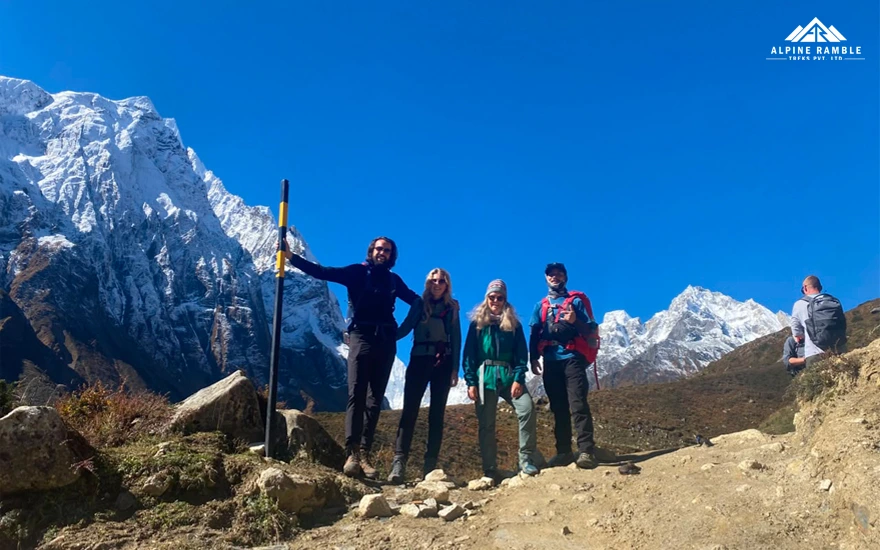
Manaslu isn't one trek. It's three, stitched together over twelve to fourteen days. You'll sweat through humid river valleys, layer up through alpine forest, and finally face genuine high-altitude cold at Larke Pass, often within the same week. A packing list that treats all of that as one uniform "Himalayan trek" will leave you either overloaded in the lowlands or underprepared at the pass.
The core of a good Manaslu packing list isn't a longer inventory. It's the right item for the right zone, a layering system built around function rather than guesswork, and enough redundancy to cover the fact that there's no gear shop waiting for you past Jagat. Get the sleeping bag rating right, get the glove and layering system right, and break in your boots weeks before you land in Kathmandu. Those three decisions do more for your trek than anything else on this list.
Use the zone-by-zone checklist above as your starting point, adjust it to your own season and comfort level, and pack with the route in mind, not just the destination.
Frequently Asked Questions (FAQs)
1. What should I pack for the Manaslu Circuit Trek?
Pack for three distinct climate zones: lightweight, breathable clothing for the subtropical lowlands; layered mid-weight gear for the alpine forest section; and full cold-weather gear (down jacket, -15°C sleeping bag, insulated gloves) for the high glacial zone near Larke Pass. A three-layer system: base, mid, and outer shell, covers all three zones efficiently.
2. How cold does it get at Larke Pass?
In spring and autumn, nighttime temperatures near Larke Pass typically range from -10°C to -15°C, colder with wind chill. In winter, temperatures can drop to -20°C to -30°C, which is why most trekkers avoid crossing the pass outside the standard spring and autumn seasons.
3. Do I need a down jacket for the Manaslu Circuit Trek?
Yes. A down jacket (700-fill or 800-fill) is essential for the high-altitude sections above Samagaon, particularly for evenings and the Larke Pass crossing, where temperatures regularly drop below freezing.
4. What sleeping bag rating do I need for the Manaslu Circuit Trek?
A four-season sleeping bag with a comfort rating of at least -15°C is recommended, since nighttime temperatures near Samdo and Larke Pass regularly fall into that range during peak trekking seasons.
5. Can I buy trekking gear in Kathmandu before the Manaslu trek?
Yes, Kathmandu (particularly Thamel) has numerous gear shops and rental options, and it's the recommended place to fill any gaps in your packing list. Once the trek passes Jagat or Deng, there are no shops for trekking gear along the route.
6. How many kilograms can a porter carry on the Manaslu Circuit Trek?
Most agencies set a porter weight limit of around 12–15kg per trekker, split into duffel bags. This is a key reason to pack efficiently rather than bringing "just in case" items.
7. What is the best season to trek the Manaslu Circuit?
Spring (March to May) and autumn (September to November) are the most popular seasons, offering the most stable weather, clearer mountain views, and passable conditions at Larke Pass.
8. Do I need trekking poles for the Manaslu Circuit Trek?
Yes, trekking poles are strongly recommended, especially for the steep, uneven terrain from the mid-altitude villages onward and for stability crossing Larke Pass.
9. What permits do I need for the Manaslu Circuit Trek, and should I carry physical copies?
You'll need a Manaslu Restricted Area Permit (RAP), a Manaslu Conservation Area Permit (MCAP), and an Annapurna Conservation Area Permit (ACAP) for the final section. Physical copies are required at checkpoints along the route, not just digital or phone versions.
10. What's the biggest packing mistake trekkers make on the Manaslu Circuit?
The most common mistake is packing for the destination (Larke Pass) rather than the whole route, leading to overpacked cold-weather gear that goes unused in the warm lowland days and underpacked cold-weather gear that's inadequate once trekkers reach the high-altitude sections.