Monjo - The Moment Khumbu Stops Being a Route and Starts Becoming Real

Dil Gurung
Updated on March 30, 2026

The Moment Khumbu Stops Being a Route and Starts Becoming Real

You don’t arrive in Monjo with excitement.
You arrive in Monjo without noticing.

It comes after Phakding, when the trail has already lulled you into thinking this journey will stay easy, social, almost casual.

Then something shifts.

Not dramatically.
Quietly.

And if you miss it here, you spend the rest of the trek catching up.


Where you actually are, not where the itinerary says you are

Monjo sits at about 2,835 meters, at roughly 27.804° north and 86.714° east of the Khumbu Valley of Nepal.

Those numbers matter less than what they do to you.

At this height, your body is still comfortable, but no longer careless.
Your breathing deepens without asking permission.
Your pace adjusts before your mind does.

This is the last place where your body and the mountain are still negotiating gently.

After this, the mountain starts deciding more.


The gate that most people walk through without understanding

Just above Monjo, you pass into Sagarmatha National Park.

You will show your permit.
Someone will write your name.
You will walk through a wooden gate.

It feels administrative.

It is not.

This park was established in 1976, protected under laws written in 1973, and recognized globally in 1979.

That means everything beyond this point is not just land.
It is a protected system that includes glaciers, forests, wildlife, and communities that have adapted here for centuries.

So when you step past that checkpoint, you are not just continuing a trek.

You are entering a controlled Himalayan environment where every step is part of something larger.


Before Manjo, you walk. After Monjo, you begin the trek

From Lukla to Phakding, the trail feels forgiving.

You talk more than you observe.
You walk faster than you should.
You underestimate what is coming.

From Manjo toward Namche Bazaar, the tone changes.

The climb is not sudden.
That is why it catches people.

It builds slowly, then stays with you.

If you rushed through Manjo, this is where it shows.

If you slowed down in Manjo, this is where it helps.


The river that explains the valley better than any guide

The Dudh Koshi River flows beside you through Manjo.

Most people notice its color.
Few think about what it is.

This river begins as glacial melt from the Everest region, carrying ground rock that gives it that milky appearance.

It does not end here.

It moves through Nepal, into India, becoming part of a system that supports agriculture, cities, and millions of lives.

So when you stand near it in Manjo, you are not just beside a river.

You are standing near the beginning of something that does not stop at borders.


Who lives here, and why that matters to your journey

Manjo is small.
A few hundred people at most.

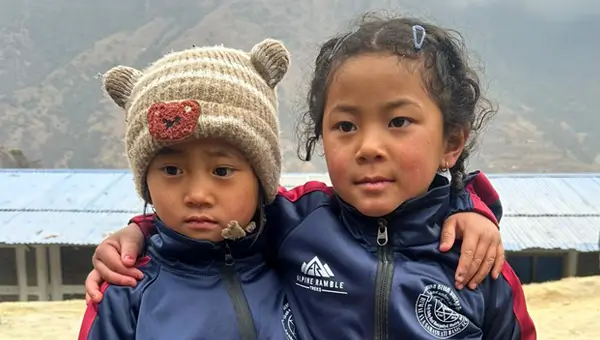
Mostly Sherpa families.

Sherpa does not mean guide.
It means people from the east, referring to migration from Tibet around the 16th century.

That means the people serving you tea, running lodges, or passing you on the trail are not visitors.

They are part of a long adaptation to altitude, climate, and terrain that most of us only pass through for a few days.

Names like Tenzing Norgay and Sir Edmund Hillary are often remembered for the summit.

But what shaped this region is what happened after 1953.

Schools were built.
Bridges were installed.
Trails became accessible.

The modern trek exists because local life continued, not because tourism arrived.


The suspension bridges are not scenery

You cross several suspension bridges before and after Manjo.

Most people take photos in the middle.

Few notice what they represent.

Before the 1960s, crossing these rivers was seasonal, unpredictable, and often dangerous.

The modern steel bridges you walk on today came through coordinated efforts, including support from Hillary’s Himalayan Trust.

These bridges turned isolated settlements into connected routes.

Without them, Everest Base Camp would still be an expedition, not a trek.

So when the bridge sways under your feet, it is not just movement.

It is history holding you up.


The forest you are about to lose in Manjo

Manjo sits in a forest zone that slowly disappears as you go higher.

Pine, fir, and rhododendron surround you here.

In spring, rhododendrons bloom across entire hillsides.

Birds move through this space more actively than most trekkers notice.

The Himalayan Monal, Nepal’s national bird, lives here.
So do blood pheasants, snow pigeons, and high-altitude choughs.

Naturalists like Brian Houghton Hodgson studied species in these regions long before trekking became common.

Once you move higher, this biodiversity reduces.

Manjo is your last dense, living green environment.

After this, the landscape simplifies.


What you eat here is more important than you think

Manjo is not about food variety.

It is about food reliability.

Dal bhat is the most important meal you will eat here.
Rice, lentils, vegetables, sometimes meat.

It is not exciting.

It is effective.

You will also find noodles, fried rice, eggs, Tibetan bread, tea.

No specialty cafes.
No curated menus.

Just meals designed to keep you moving.

And that matters more than taste once altitude increases.


The mountains you see before Everest appears

From Manjo, peaks like Thamserku, Kongde Ri, and Kusum Kanguru shape your skyline.

They are not warm-up mountains.

They are reminders.

Everest is not the only presence in Khumbu.

It is simply the most recognized one.

Understanding that early changes how you experience the rest of the trek.


What most people do wrong here

They rush.

They treat Manjo like a checkpoint.

They walk through without stopping, without adjusting, without noticing.

And then they struggle later.

Not because the trek is too hard.

Because they skipped the place that prepares them.


What you should actually do in Monjo

Slow down before you are forced to.

Drink water before you feel thirsty.

Eat even if you are not hungry.

Stand by the river for a few minutes.

Look at the bridges instead of just crossing them.

Pay attention to your breathing.

Because after this point, the trek will demand more than it has so far.


Why Monjo becomes the most awaited place once you understand it

The first time you pass Manjo, you barely notice it.

The second time, you remember it.

The third time, you wait for it.

Because you realize this is where everything still feels balanced.

Your body is still adapting.
The air is still manageable.
The landscape still has life in it.

It is the last place where the journey feels open rather than demanding.


Sources and references 

Government and official bodies

International organizations and research

Historical and expedition records

  • Royal Geographical Society expedition archives (1921–1953 Everest expeditions)

  • Himalayan Trust archives (founded 1964 by Edmund Hillary)

  • British Everest Expedition Reports (1921, 1922, 1924)

Academic and scientific contributors

  • Joseph Dalton Hooker botanical studies (1840s Himalaya)

  • Brian Houghton Hodgson Himalayan wildlife documentation

  • Journal of Mountain Science

  • Himalayan Journal (The Alpine Club)

Military and mapping references

If you reach Everest Base Camp, you will remember the view.

If you understand Monjo, you will understand the journey.


Need Help? Call Us+977 9813593530orChat with us on WhatsApp
Offer Packages
Everest Base Camp Trek
Best Seller

Classic Everest Base Camp Trek 14 Days

Price From
US$1299US$1599
noimage
Most sellert

Ama Dablam Base Camp Trek with Everest Base Camp – 15 Days

Price From
US$1780US$2000
COMFORTABLE EVEREST BASE CAMP TREK
Guaranteed Departures

COMFORTABLE EVEREST BASE CAMP TREK

Price From
US$1290
16 Days Everest Basecamp Kalapathar Trek
Guaranteed Departures

16 Days Everest Basecamp Kalapathar Trek

Price From
US$1175